








































How to Identify and Source Genuine Motorcraft Starter Motors: Authorized Channels and Supplier Verification
A Motorcraft box proves the brand, not what is inside it or where it came from. Here is how to verify the part number, the seller, the paperwork and the unit itself before you pay.
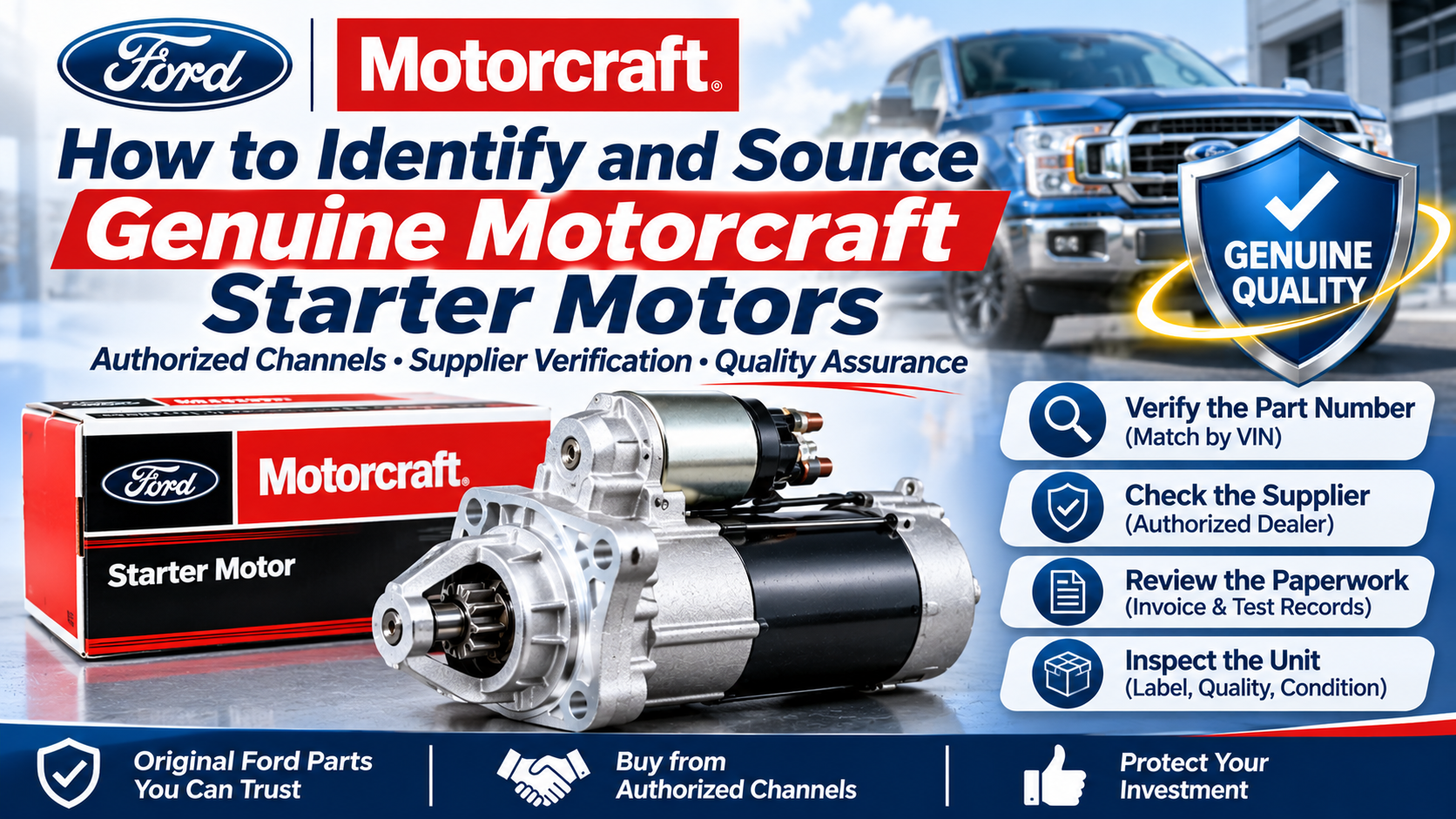
Short answer: start with the VIN-derived part number, not the logo. Motorcraft is Ford's parts brand and covers both new and remanufactured starters, so the label — not the brand — tells you which line you are holding. Verify the seller's authorization independently, get the current number and its supersession in writing, and inspect the delivered batch. A low price is not proof of a fake, but it is a reason to ask which of three things was cut: copper, iron, or insulation.
What does "genuine" actually mean on a starter box?
Most buyers assume the risk is the obvious fake. In practice the risky unit has the right logo and the wrong content: a remanufactured unit sold as new, a superseded number sold as current, or a correctly branded box holding a part from another engine code. All of these pass the "is the logo real?" test.
| What the seller says | What it actually proves |
| "Motorcraft" | The brand line only; new and reman both carry it |
| "Fits 3.5L V6" | Nothing about the exact application — match by VIN |
| "OE quality" | A phrase, unless a spec and test record are named |
| "In stock, cheap" | Availability and price, not traceability |
Ask for a photograph of the label on the actual unit, not a catalogue image. Read the part number, the new-or-reman indication, the date code and the batch code. No photo, no order.
How do authorized channels differ from a marketplace listing?
An authorized dealer can put a legal entity name on an invoice, name the part number sold and explain where the unit came from. A marketplace seller can do all of that too — but does not have to. The difference is what you can verify and what you can recover if the part fails.
If a supplier claims authorization, ask which authorization they hold and for current evidence. Then confirm it with the brand's regional parts office or customer service. A logo on a website is self-declared; a number the brand confirms is not.
Three questions separate a stocking supplier from a reseller:
- Can they run your VIN and print the current part number, including its supersession? Ford replaces part numbers routinely; a different suffix letter can still be the correct current part.
- Does the invoice carry the part number and batch code, not just "starter motor"? Without that, a warranty claim has nothing to attach to.
- Is the return a counter transaction or an email thread? That matters more than a small price difference when a unit fails in month seven.
Verify the application before you verify the price
A starter sharing a bellhousing pattern is not automatically the right starter. The mismatches that generate comebacks sit at the edges:
- Pinion tooth count. A 10-tooth drive on an 11-tooth ring gear will crank once and then grind.
- Drive-end clocking. Index the nose housing wrong and the solenoid fouls the block or a terminal ends up against the exhaust.
- Terminal style and stud length. Spade versus ring, side-post versus top-post, and model-year changes all matter.
- Flange and overall length. A unit from a later engine code may share the bolt pattern and sit deeper.
Match by VIN, confirm the number, then confirm the supersession.
What documents should a real supplier provide?
- Authorization evidence that you have verified independently.
- An invoice naming the legal entity, part number, quantity and batch code.
- Production-lot test records, not a sample certificate — reports usually cover a sample, while reduced copper, iron or insulation class appears in the production unit after type approval.
- Agreed critical dimensions — wire gauge, bearing model, housing dimensions — so a delivered unit can be compared with the approved version.
- Warranty in writing, including labour and core-credit terms. A parts-only warranty that leaves you paying labour twice is worth less than a shorter one with labour.
- A retained-sample arrangement. One or two sealed units per batch give you something to compare against when a batch problem appears.
Ask for data, not the word "qualified". For an incoming batch, keep records of insulation resistance, ground continuity and a bench test, with conditions stated. Our source note on temperature rise was written for continuous-duty motors; a starter is short-duty, so do not copy a "run to thermal stability" method into its acceptance clause.
What should you check on the unit that arrives?
| Check | What it catches | Note |
| Winding insulation | Downgraded insulation class, moisture | Winding to case |
| Ground continuity | Poor ground path, high cranking drop | Case to mounting face, terminal to case |
| Temperature rise | Reduced wire, reduced iron, weak cooling | Short-duty method, not continuous-duty |
| Label verification | Wrong number, wrong line, wrong voltage | Compare with invoice and approved version |
| Mechanical condition | Downgraded bearing, weak dynamic balance | No-load noise and vibration |
Two items matter most. A wire gauge reduced by 0.1 mm on a 1 mm wire means roughly 20% less copper cross-section — a geometric calculation, not a brand figure — raising resistance and heat in a short-duty, high-current machine. The label ties that physical unit to your paperwork.
Why can a "passed" report still be useless?
A report listing no-load current, speed, insulation and withstand voltage as "passed" tells you little without conditions. Bench tests use room temperature and steady supply; the real unit sits near a hot exhaust, under vibration, with a sagging battery. A starter at 9 V behaves very differently from one at 12.6 V. Compare conditions before arguing about quality. Standards are a minimum threshold, not a service-life promise — write real operating conditions into acceptance terms.
When the new starter did not fix it
Many "bad out of the box" starters are fine; the circuit is still losing voltage. Cranking pulls several hundred amps through the ground path, and the loss is invisible at the battery posts. Measure from the starter case to battery negative while cranking. On a 12 V system, under 0.2 V is our reference and over 0.3 V points to a corroded strap or painted face — confirm for your model in the service manual. Total cranking drop is commonly referenced at 0.5 V or less.
When to stop and hand it over
The main stud is live and unfused: disconnect the negative cable first. Support the vehicle, torque the bolts, and do not pry on the nose housing. Crank in short bursts with rests — starters are short-duty. Chewed ring gear teeth or a worn flexplate is not a starter problem. On stop-start, mild-hybrid and high-voltage systems, diagnosis and HV work belong to a qualified technician.
Send us the VIN, the part number printed on the label of your current unit, your annual quantity and the target market. We will confirm the correct current number, state clearly whether the line is new or remanufactured, and tell you which test records can be supplied before you place an order.


Comments 0
Comments are moderated before publication. Please do not share personal or sensitive information.