


































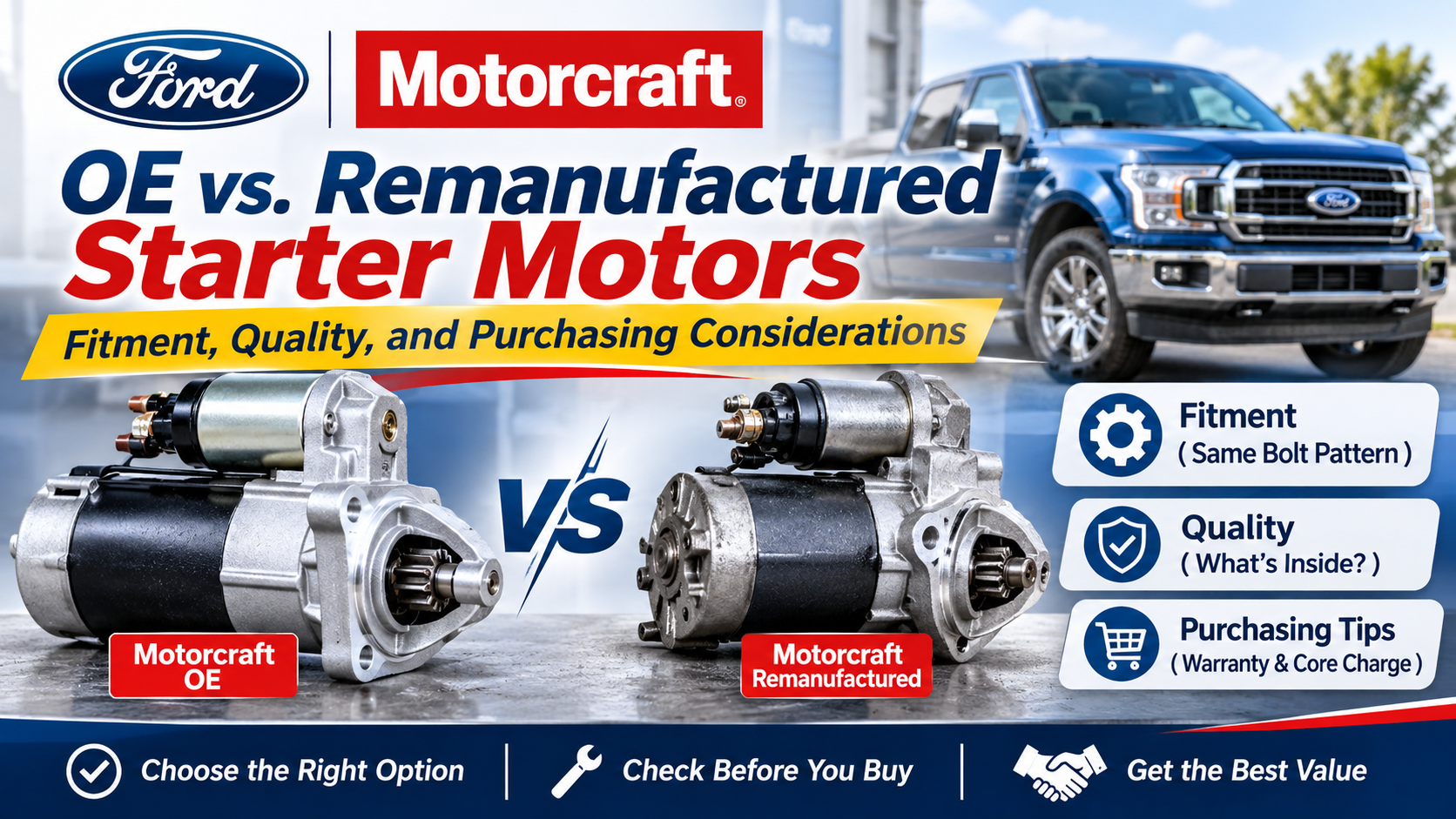
Motorcraft OE vs. Remanufactured Starter Motors: Fitment, Quality, and Purchasing Considerations
Motorcraft OE and remanufactured starters bolt to the same holes. What differs is what was reused, how it was tested, and what the warranty really covers. Here is how to choose and how to check the part before you pay.
Do OE and remanufactured starters fit the same?
Physically, yes — the reman core started life as the same casting. But "fits" is doing a lot of work in that sentence, and the mistakes happen at the edges:
- Pinion tooth count and diameter. Same engine family, different flywheel, different pinion. A 10-tooth drive on an 11-tooth ring gear will crank once and then grind.
- Drive-end clocking. The nose housing can be indexed in more than one rotation. Bolt it up wrong and the solenoid body fouls the block or the terminal ends up against the exhaust.
- Solenoid terminals and the small-wire connector. Spade versus ring, side-post versus top-post, and the length of the S-terminal stud all vary by model year.
- Mounting flange and overall length. A starter from a later engine code may share the bolt pattern but sit 10 mm deeper.
Do not match by the marketplace string "fits 3.5L V6." Match by VIN, then confirm the part number and its supersession. Ford replaces part numbers routinely; a box with a different suffix letter can still be the correct current part, and a box with the right number can be a return that was put back on the shelf. Ask the counter to run the VIN and print the number — that is a 30-second check that prevents most "wrong part" comebacks.
What is actually different inside?
Both are the same architecture: series-wound DC motor, solenoid, overrunning clutch drive. The difference is what the rebuilder chose to renew.
A starter core carries four expensive pieces: the drive-end and commutator-end frames, the field coils, the armature, and the drive assembly. A proper reman replaces the wear items — brushes, solenoid contacts, bearings, drive — and qualifies what it keeps: armature tested bar-to-bar on a growler, commutator turned and undercut, field coils insulation-tested, housing bores measured.
The economy version of the same process skips the qualification and keeps more of the core. Three shortcuts show up repeatedly:
1. A rewound armature with less copper. Strip an armature and the stator slots deform slightly; the easy way to refit the winding is to go down one wire gauge. On a 1 mm wire, 0.1 mm off the diameter is roughly 20% less copper cross-section — higher resistance, more heat at the same current, lower maximum torque. Cranking is a short-duty, high-current event, so the heat has nowhere to go. This is the single most common reason a rebuilt starter "burns out again" within weeks.
2. A reused end frame with a worn bearing bore. Starter end frames are thin-wall aluminium or engineering plastic, and aluminium expands at roughly twice the rate of steel. The interference fit that holds the bearing is lost at operating temperature, the outer race spins in the bore, and the housing wears into a groove. It cannot be sleeved — the wall is too thin — so a rebuilder who reuses that frame is selling you a noise and a short life. If a reman fails with a metallic growl rather than a no-crank, this is usually why.
3. Wrong or excessive grease. Starter bearings are sealed and pre-greased for life. Too much grease in the nose finds its way onto the commutator, glazes the brushes, and drops cranking current.
| Ford OE new | Motorcraft reman | Unbranded reman | |
| Armature | New | New or rewound to spec | Often rewound, gauge unverified |
| End frames | New castings | Reused if bore is in spec | Reused, bore rarely measured |
| Brushes, solenoid contacts, drive | New | New | New, grade varies |
| Test before boxing | Full production test | Bench test per Ford spec | No-load spin only |
| Warranty | Ford new-part coverage | Ford reman coverage, typically similar term | Seller's terms, often parts only |
| Realistic life | Design life | Shorter than new; depends entirely on the rebuilder | Unpredictable |
What to check before you pay
- Which line is in the box. Motorcraft is Ford's parts brand and covers both new and remanufactured starters. The label, not the brand, tells you which one you are holding. If a listing says "Motorcraft" and never says "remanufactured," ask directly.
- Core charge and core condition. The core is your old starter, and its value is deducted only if it comes back complete and rebuildable — no cracked housing, no burnt-in core, no missing solenoid. Read the core policy before you leave the counter, not after.
- Warranty, including labour. A 24-month parts warranty that leaves you paying the labour twice is worth less than a 12-month warranty with labour. Get the labour position in writing.
- Date code. Sealed grease and bare steel do not improve with age. A part that has sat on a shelf for four years is a part with a shorter life.
- Return path. Buy where a return is a counter transaction, not an email thread with a marketplace seller. This matters more than a 10% price difference.
The new starter that did not fix it
Most "bad out of the box" starters are not bad. They are doing their job in a circuit that is still losing voltage.
Cranking pulls several hundred amps through the ground path — block to chassis to battery negative — and that path is where the loss hides. With the engine cranking, measure from the starter case to the battery negative post: under 0.2 V is healthy on a 12 V system, and over 0.3 V points to a bad ground strap or a painted mounting face. Total cranking drop at the starter is commonly referenced at 0.5 V or less; check your service manual for the figure that applies to your model.
A starter fed 10 V instead of 12 V draws more current for the same torque, runs hotter, and dies early — and it will take the replacement with it. Likewise, a solenoid contact that sticks and lets the engine drag the starter after start-up will destroy any starter, new or reman.
When to stop and hand it over
Disconnect the negative cable first — the main stud is live and unfused. Support the vehicle properly, and torque the mounting bolts rather than tightening by feel. Do not pry on the nose housing to break it loose.
Crank in short bursts with a rest between attempts; starters are short-duty machines, and long grinding is how armatures get cooked. If the ring gear teeth are chewed or the flexplate has a bald patch, a new starter will be chewed too — that is transmission-side work, and no starter purchase fixes it.
If the vehicle is a daily driver you plan to keep, or it tows, or it sees real cold, the arithmetic favours new OE: you are paying once instead of twice. If it is an older second vehicle in a mild climate and you can name the rebuilder, a reman with a real warranty is a rational buy. What is never rational is an unbranded reman with an unknown armature and a warranty that covers the part only.


Comments 0
Comments are moderated before publication. Please do not share personal or sensitive information.