






































Motorcraft Starter Motor Selection and Inventory Management for Repair Networks and Parts Distributors
For repair groups and parts distributors, starter selection is a VIN-and-spec decision, and inventory is a controlled set of fast movers. Here is how to choose the right units, size your stock, and keep it from turning into warranty claims.
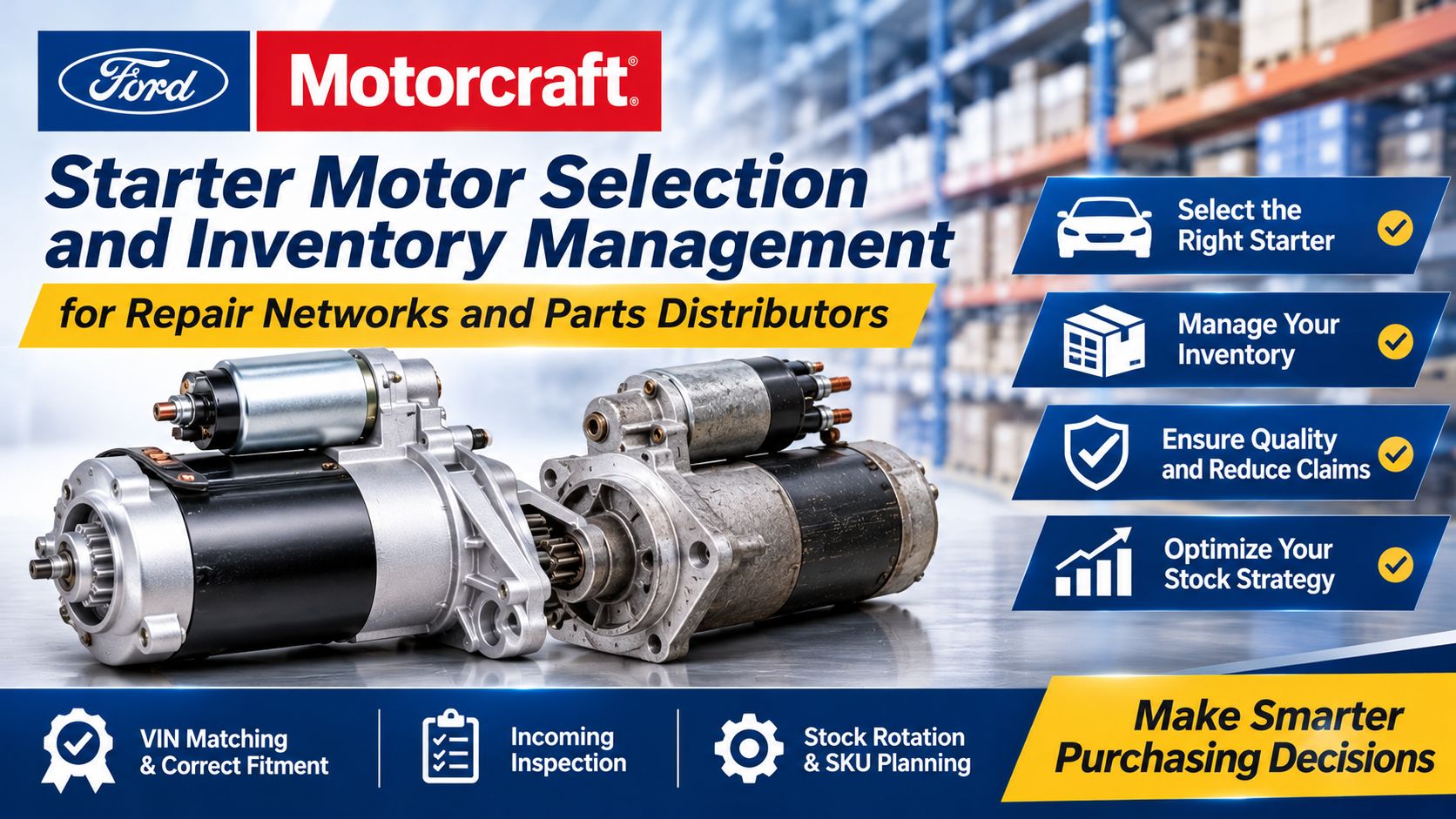
Short answer: "the right starter" is not the one with the matching bolt pattern — it is the VIN-derived number with the correct pinion count, clocking, terminals and electrical rating, verified against the label. Stock fast movers by application and region, buy new OE for cold-climate and stop-start fitments and a documented reman for the rest, and test every incoming batch. Selection errors and stock ageing, not manufacturing defects, drive most of the comebacks a distributor pays for.
What does "the right starter" actually mean for a shop network?
Three questions, in this order:
- Application. Run the VIN and print the current Motorcraft number, including its supersession. Ford changes numbers routinely; a different suffix letter can still be the correct current part. "Fits 3.5L V6" is not an application check.
- Mechanical interface. Four edges a shared bellhousing does not cover:
- Electrical and duty. Voltage, rated power and load must match. A starter is a short-duty (S2) machine matched to peak torque with little headroom, so "a bigger one" is not an upgrade — it can over-torque the ring gear or overload the harness.
| Selection axis | What to confirm | Why it matters in stock |
| VIN-derived number | Current number + supersession | Stops old stock being sold as current |
| Pinion / ring gear | Tooth count and drive geometry | Wrong count grinds on first crank |
| Clocking / terminals | Nose index, stud type and length | Comeback even when the bolts line up |
| Voltage / rating | System voltage and specified rating | Wrong rating fails under load |
| Duty environment | Heat, water, salt exposure | Decides sealed / high-temp / stainless options |
Why "same bolt pattern" is not the same starter
Many distributors assume that if the mounting ears line up, the unit is interchangeable. In practice comebacks sit at the edges: the pinion, the clocking and the part number. A starter can bolt in and pass a bench spin, then fail on the first cold morning — because the drive is cut for a different ring gear, or the "current" catalogue number was already superseded twice.
Match by VIN, confirm the number and supersession against the physical label, then record both on the invoice. Without the number and batch code on paper, a warranty claim has nothing to attach to.
New OE or reman — which lines should you carry?
You rarely need both in every SKU. A working rule:
- New OE for keepers, tow vehicles, cold-climate daily drivers and stop-start or mild-hybrid fitments — where a comeback costs a second labour operation.
- Documented reman for older vehicles in mild climates, with a named rebuilder, a test record and labour in the warranty.
- Avoid the unbranded reman with an unverified armature and parts-only cover.
The label says new or reman; the Motorcraft brand does not — it covers both. If a listing only says "Motorcraft," ask. (Internal differences are covered in our separate guide on OE versus remanufactured starters.)
How many SKUs should a distributor actually stock?
Stock by application density and climate, not by catalogue breadth. A practical tiering:
- Tier 1 — fast movers. The handful of VIN-derived numbers covering most of your local fleet and regional climate. Keep depth here; these turn often enough that date codes stay current.
- Tier 2 — seasonal and regional. Cold-climate and high-heat fitments, plus stainless or high-temperature bearing options for coastal, salted-road and worksite fleets. Stock shallow, reorder against lead time.
- Tier 3 — special order. Low-volume engine codes, unusual clocking and early model years. Do not tie up cash; order against a confirmed VIN and number.
The environment tier is not optional. A standard bearing fails early in salt and water; a unit near the exhaust needs high-temperature tempering — conventionally around 160 °C / 3 h, with 180, 220 and 250 °C options for hot locations, specified from the supplier's data sheet. Starters use sealed, pre-greased bearings; do not plan to re-grease them in the field.
What does incoming inspection on a batch require?
A supplier's certificate usually comes from a sent sample, while problems appear in the production lot. Test a few units from the delivered batch:
| Check | Method | What it catches |
| Winding insulation | Insulation tester, winding to case | Downgraded class, moisture |
| Ground continuity | Milliohm meter, case to mounting face | Poor ground, high cranking drop |
| Temperature rise | Short-duty bench method | Reduced wire, iron or cooling |
| Label verification | Compare with invoice and approved version | Wrong number, line or voltage |
| Mechanical condition | No-load noise and vibration | Downgraded bearing, weak balance |
Three shortcuts cause most early failures: less copper in a rewound armature, a reused end frame with a worn bearing seat, and excess grease migrating to the commutator. As a geometric reference — not a brand figure — shaving 0.1 mm off a 1 mm wire removes roughly 20% of the copper cross-section; on a short-duty, high-current machine that means resistance, heat and lost torque. A continuous-duty temperature-rise method does not apply to a starter.
Keep one or two sealed units per batch as a retained sample — the only honest comparison when a batch problem surfaces months later.
How do you keep stock from ageing into a claim?
- Rotate by date code, not just by bin. Sealed grease and bare steel do not improve in storage; ship the older code first.
- Track the core. Core credit normally needs a complete, rebuildable unit — no cracked housing, burnt armature or missing solenoid. Set the rule before the first core goes back.
- Write the warranty around labour. A parts-only term that makes the shop pay twice for the same replacement is worse than a shorter term that includes labour.
- Close the loop on every comeback. While cranking, measure from the starter case to battery negative: under 0.2 V is a commonly referenced guide on a 12 V system, over 0.3 V points to a corroded strap or painted face, and total drop is often referenced at 0.5 V or less — confirm in the service manual. Many "bad out of the box" units are fine; the circuit is losing voltage. Crank in short bursts: starts over five seconds or repeats closer than 15 seconds are experience figures, not manual limits.
When to stop and hand it over
The main stud is live and unfused: disconnect the negative cable first. Support the vehicle, torque the bolts and do not pry on the nose housing. Chewed ring gear teeth or a worn flexplate is not a starter fault. On stop-start, mild-hybrid and high-voltage systems, diagnosis and HV work belong to a qualified technician. Electrical checks and bench work should be carried out by trained staff.
Send us the VINs of your highest-volume applications, your target market and climate, and your annual quantity by number. We will confirm the current Motorcraft number and supersession for each, state whether the line is new or remanufactured, and tell you which production-lot test records we can supply — before you commit stock.


Comments 0
Comments are moderated before publication. Please do not share personal or sensitive information.