




































Common Small Engine Starter Problems: Troubleshooting and Repair Procedures
A small engine that won't start is usually blamed on the starter — but most "starter problems" are a weak battery, a bad ground, or a fuel and ignition fault. Here is how to tell which one you have, the checks that separate them, and when to stop and hand it over.
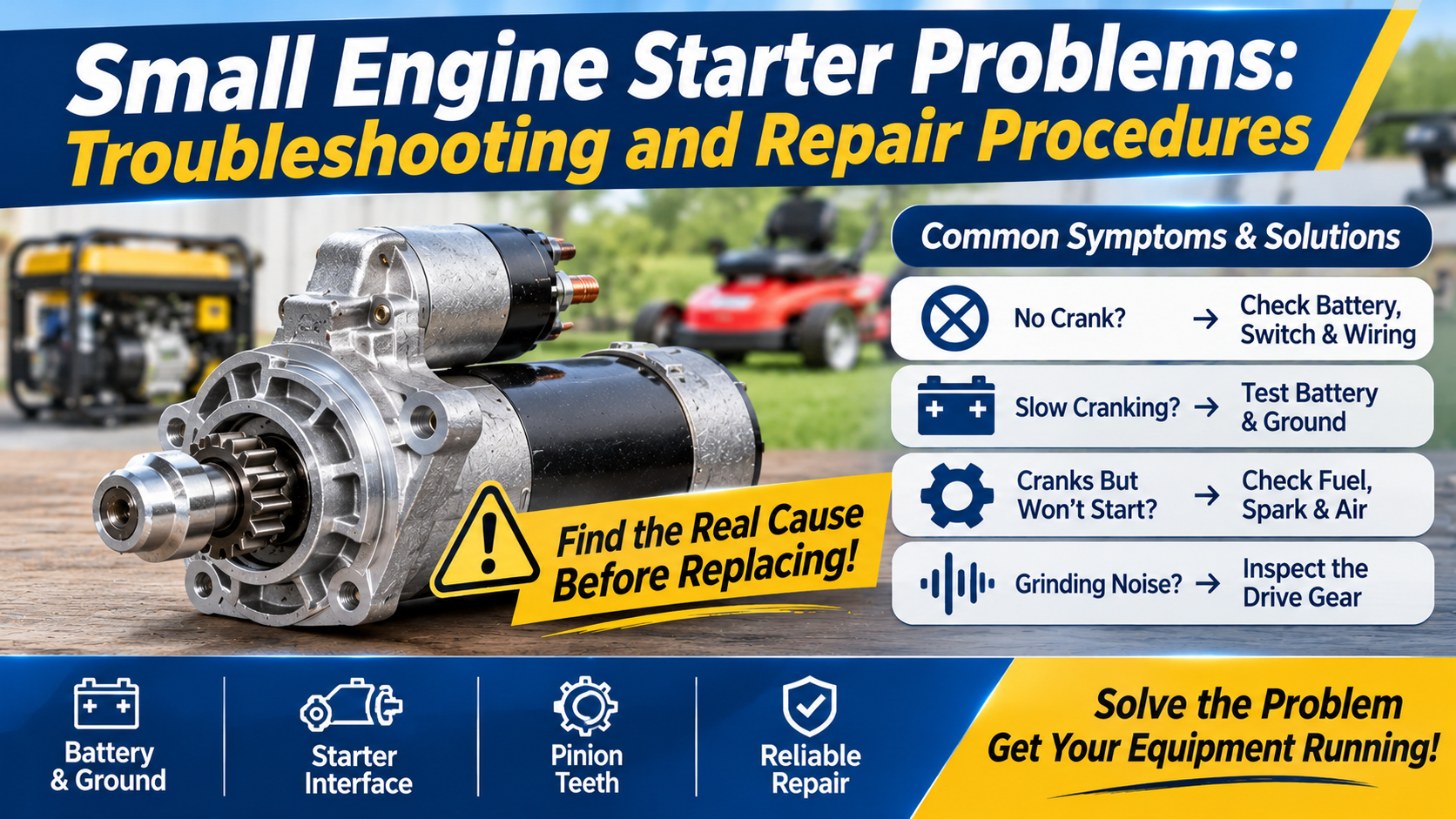
Short answer: before you replace anything, split the symptom into three questions. Does it crank at all? Does it crank slowly? Or does it crank normally but the engine never fires? Those three point to different systems. A starter that does not turn is usually an electrical supply or control problem. A starter that turns slowly is usually a battery or ground problem. A starter that spins the engine strongly but nothing happens is usually fuel, ignition or compression — the starter has already done its job. Work in that order and you will avoid the most expensive mistake in small-engine repair: fitting a new starter to a machine whose starter was never the fault.
Is it a starter problem at all? Start with three questions
A starter has one job: spin the crankshaft fast enough for the engine to fire. It cannot make fuel, make a spark, or set timing. So the first check is not a tool — it is listening and watching.
| What you see and hear | What it actually means | Where to look first |
| Silence — no click, no turn | The command never reached the starter, or supply is gone | Battery, main fuse/connection, safety interlocks, control circuit |
| A single click, no turn | Solenoid engaged, but main contacts or supply are weak | Battery under load, ground, solenoid contacts |
| Slow, weak, "grunting" crank | Supply or ground is losing voltage under load | Battery, cabling, ground path |
| Fast, clean crank, engine won't fire | Starter is fine — fuel, spark or compression is missing | Fuel, ignition, choke, compression |
| Grinding, clattering or a high-pitched spin | Drive gear, ring gear or one-way clutch | Pinion engagement, ring gear, drive clutch |
Only two of those five rows are genuinely a starter problem. The rest are supply, control or engine faults that wear the starter out if you keep pressing the button.
No crank at all: check the command before the part
When nothing happens, the instinct is "the starter is dead." On equipment that sat over a season, the far more common causes are a flat battery, a corroded connection, or a safety interlock that is not satisfied. On riding mowers and generators, the seat switch, brake/neutral switch, blade-engage switch and the kill or ignition switch all have to agree before the starter gets power. A dirty or stuck interlock looks exactly like a bad starter.
Work in this order:
- Check the battery and main connections — terminals tight and clean, no corrosion at the posts, fuse intact.
- Check the interlocks — brake or neutral engaged, PTO/blades off, operator switch satisfied, key fully in the start position.
- Listen for the solenoid click. A click means the control side is working and power is reaching the solenoid; no click points back to supply, switch or control wiring.
- Only then test the starter itself — feed it correctly and see whether it turns.
A note on testing: a meter that reads static voltage proves very little. A weak battery can show a healthy reading at rest and collapse the moment the starter draws current. Any "no crank" diagnosis has to include a loaded test.
Slow or weak cranking: it is usually the battery or the ground
This is the classic case where people replace a good starter. The machine cranks, but slowly and weakly — worse when cold. The starter is not "tired"; it is being starved of voltage.
For a common 12 V system, three numbers separate battery trouble from starter trouble. These are general experience values for common 12 V systems, not universal limits — confirm against the equipment manual:
| Check | Commonly referenced guide | What it tells you |
| Static battery voltage | ~12.6 V full; below ~12.4 V = charge | Only rules out an obviously flat battery |
| Voltage while cranking | generally should not dip below ~9.5 V at normal temperature | A deep sag points to high internal resistance |
| Cranking-circuit drop | ~0.5 V across the whole circuit, ~0.2 V at any single point | High drop points to cabling or ground, not the starter |
Here is the "many people think X, actually Y" case: the battery reads 12.6 V, so the starter gets blamed — but the meter was reading static voltage, while the fault only appears under load. A unit stored all winter with a half-charged battery will crank slowly and overheat even though nothing is wrong with the starter. Fix supply first. Replacing starters without testing the battery and ground just repeats the failure — and a starter that is repeatedly fed low voltage will eventually burn out for real.
The ground path matters as much as the positive cable. On most small engines the starter grounds through its housing to the engine and back to the battery negative, often with no separate ground wire. Rust, paint, or a loose mounting bolt at that path eats voltage the meter at the battery never sees. Clean to bare metal, tighten, and re-test the drop under load.
Cranks normally but won't fire: prove the starter innocent first
If the engine spins fast and cleanly and simply will not start, stop looking at the starter. It has already done its job. On a small engine the short list is fuel, spark and air:
- Fuel — old fuel left over the winter, a blocked or flooding carburettor, a clogged fuel line or filter, or the choke in the wrong position. Stale fuel is one of the single most common causes of seasonal "won't start."
- Spark — a fouled or cracked spark plug, a failed magneto coil, a loose plug lead, or a kill switch grounding the ignition.
- Air and compression — a blocked air filter, or low compression from valve or bore wear.
A clogged air filter or stale fuel is a two-minute check and costs almost nothing; a replacement starter is not. Rule out the cheap causes first. If compresssion is genuinely low, that is an engine repair, not a starter purchase.
Repeated burnout and grinding: two faults that finish starters off
Repeated burnout is almost never a bad starter batch. Trace it back: low supply voltage, a poor ground, or holding the button too long. A starter is a short-time-duty device, built for a few seconds of cranking and then a long cool-down. A common rule of thumb is cranking bursts of no more than about five seconds, roughly fifteen seconds between attempts; if it does not fire after three tries, stop and find the cause. Treat those times as experience figures, not manual limits. Fitting a bigger starter to "fix" a hard start does not help — it can over-torque the ring gear or draw more current than the wiring was designed for.
Grinding, clattering or a high-pitched free spin points at the drive. A worn one-way clutch lets the starter spin without turning the engine; damaged or missing ring-gear teeth make a periodic metallic knock. A single thump and shudder at the moment of engagement is normal — the pinion slams into the ring gear under load. A shudder that lasts the whole crank, or a continuous rattle, is not.
If the pinion teeth, nose housing indexing, terminals or mounting depth differ from the old unit, a replacement may crank once and then grind. Match the interface to the old unit and the parts label before ordering.
When to stop and hand it over
Small engines involve rotating parts, fuel and a live — usually unfused — battery cable. Disconnect the negative lead before touching the starter, keep hands and clothing clear of the drive and belts, and never defeat a safety interlock or bypass the solenoid to "test" it. A machine must be securely supported before any cranking test. Diagnosis around the charging system, magneto ignition, or an unfamiliar electric-start setup belongs to a qualified technician, and final limits — voltage thresholds, engagement geometry, bearing specification — should be confirmed against the equipment manual. This article's criteria narrow the search; they do not replace the manufacturer's procedure.
Send us this before asking for a quote
Once you have narrowed it down, send these six items and we will confirm the matching starter, tell you which interface and bearing options your conditions need, and state which production-lot test records we can supply:
- Engine make, model and displacement, and whether it is a cold or warm start.
- System voltage and the battery/charging setup actually fitted.
- The exact symptom — no crank, slow crank, cranks but no fire, or noise — and when it happens.
- Cranking voltage and circuit-drop readings, if you have them.
- Old unit details — part number, pinion tooth count, terminal style, and a photo of the mounting face.
- Application and environment — generator, mower or other equipment; dusty, wet or hot — plus annual quantity and target market.
Send those and we will confirm the part, flag anything in your diagnosis that does not fit a starter fault, and give you a quote against the correct unit — not a guess.
Figures in this article are general experience values and commonly referenced guides for 12 V systems and small-engine duty, not universal standards. Confirm final limits with the equipment manual and the supplier's data sheet.


Comments 0
Comments are moderated before publication. Please do not share personal or sensitive information.