








































Evaluating Small Engine Starter Suppliers: Durability, Compatibility, and Bulk Supply Capacity
A starter that passes a bench test can still fail in the field. Here is how to judge a small-engine starter supplier on the three things that actually matter — real-world durability, interface compatibility, and whether the production batch matches the approved sample.
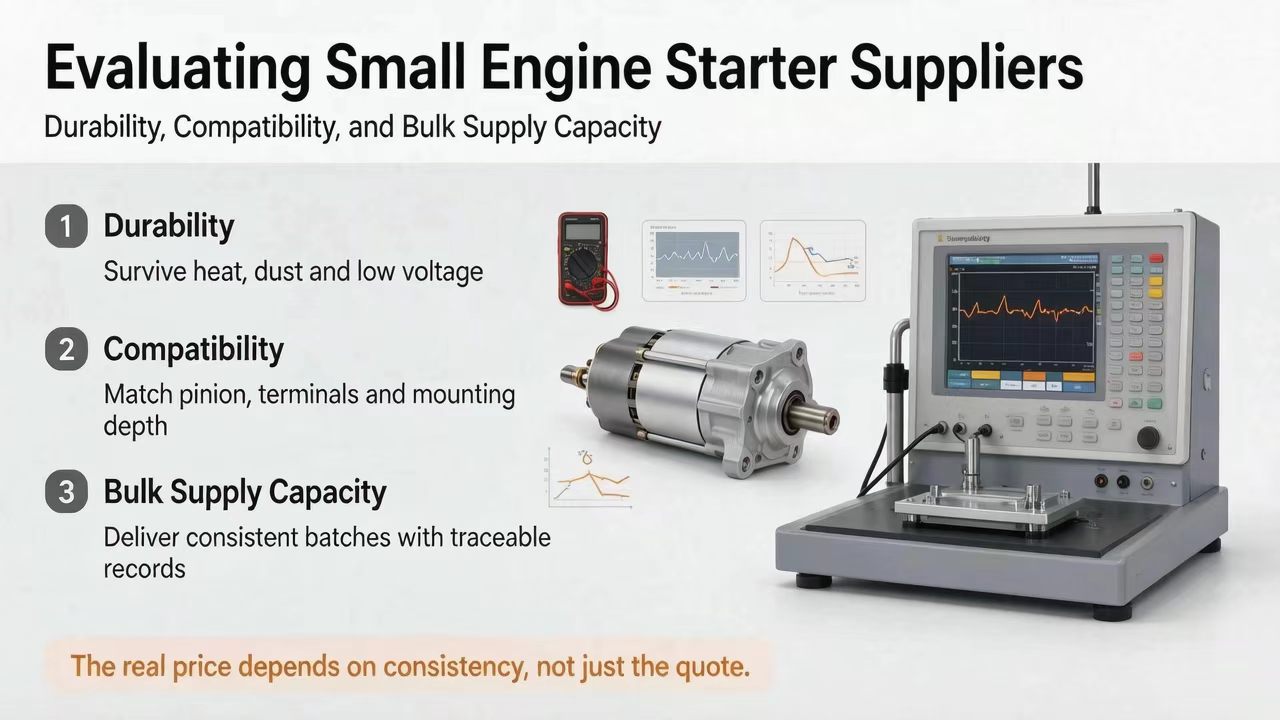
Short answer: judge a supplier on three things, not on the catalogue. Durability means the unit survives heat, vibration and low cranking voltage — not just a clean bench report. Compatibility means the pinion, clocking, terminals and depth match the old unit, not just the bolt pattern. Bulk capacity means the delivered production lot matches the sample that was approved. If a supplier can only show you a sample certificate and cannot ship consistent batches with traceable test records, the price on the quote is not the price you will pay.
What does "durability" actually mean on a small-engine starter?
A bench report showing normal no-load current, speed and insulation is not a durability result. A bench does not reproduce the three conditions that kill outdoor starters:
| Condition | What happens in the field | What to ask the supplier |
| High temperature near the engine or exhaust | Bearing grease dries early; hardness and clearance change | High-temperature bearing tempering — conventionally around 160 °C / 3 h, with 180, 220 and 250 °C options for hotter spots, specified from the data sheet |
| Grass dust, mud, rain, salt or frequent washing | Standard bearing steel rusts and seizes; dust and water get in | Sealed, pre-greased bearings as standard; stainless bearing option for wet, coastal or salted use |
| Low battery voltage | Higher current, faster temperature rise, early burnout | Whether a low-voltage crank and post-vibration condition were tested, not just a standard bench spin |
Starters use sealed, pre-greased bearings — they are not re-greased in the field. Deep-freeze bearing treatment solves long-term dimensional stability for precision equipment; on a starter it adds cost for little benefit.
The most common way cost is taken out of a batch is less copper in the winding. As a geometric reference, not a brand figure: shaving 0.1 mm off a 1 mm wire removes roughly 20% of the copper cross-section — on a short-duty, high-current machine that means more resistance, more heat and less torque. A continuous-duty temperature-rise test does not apply to a starter, which is a short-time-duty (S2) machine; ask for a short-duty method instead.
How do you verify compatibility before you commit to a batch?
"It bolts on" is not an interchange check. Most comebacks sit at the edges:
- Pinion tooth count — a drive cut for a different ring gear may crank once, then grind.
- Nose-housing clocking — index it wrong and the solenoid fouls the housing or a terminal lands near the exhaust or fuel line.
- Terminals — spade versus ring, and which post is live, can change between model years.
- Flange and depth — two frames can share a bolt pattern while the drive sits at a different depth.
- Voltage and rating — confirm system voltage and the rating against the machine, not from memory.
Confirm all five against the old unit and the parts label before ordering, and keep the number and batch code on the invoice.
One misconception worth calling out: fitting a bigger starter does not cure a hard start. A starter is matched to peak cranking torque with little spare capacity; an oversized unit can over-torque the ring gear or draw more current than the wiring was designed for. Hard starting is usually a weak battery, a poor ground, thick oil in the cold, or a fuel and compression problem.
Can the supplier actually deliver batch after batch?
Here is the "many people think X, actually Y" case: many buyers think a passed certificate proves the batch is good — but the certificate usually comes from a submitted sample, while the problems appear in the production lot. Reducing copper, iron or insulation class is something that happens after the design is approved. So the question is not "is the sample good?" but "does the delivered batch match the sample?"
Test a few units from each incoming batch:
| Check | Method | What it catches |
| Winding insulation | Insulation tester, winding to case | Downgraded insulation class, moisture |
| Ground continuity | Milliohm meter, case to mounting face | Poor ground, high cranking drop |
| Temperature rise | Short-duty bench method | Reduced copper, iron or cooling |
| Label verification | Compare with invoice and approved version | Wrong number, line or voltage |
| Mechanical condition | No-load noise and vibration | Downgraded bearing, weak balance |
Ask for test data from the production lot, with a stated sampling ratio and traceable batch — not a "pass" from a sent sample. Keep one or two sealed units per batch as a retained sample; it is the only honest comparison when a problem surfaces months later. Ask about minimum order quantity, lead time and how batch codes are marked, so a later claim has something to attach to.
For context on the supply side, a starter is a high-current, short-duration device. On a common 12 V system, cranking bursts of no more than about five seconds with roughly fifteen seconds between attempts are general experience figures — not manual limits — and the circuit drop is often referenced at about 0.5 V total, around 0.2 V at any single point. Confirm final limits against the equipment manual.
When to stop and hand it over
Electrical testing and bench work should be done by trained staff. The main battery cable is live and usually unfused: disconnect the negative lead first, secure the machine before any cranking test, and never defeat a safety interlock or bypass the solenoid to "test" it. Repeated burnout is a symptom to trace, not a part to keep replacing — low voltage, a poor ground or holding the button too long will kill one starter after another. Final limits on voltage, engagement geometry and bearing specification belong to the equipment manual and the supplier's data sheet.
Send us this before asking for a quote
- Engine make, model and displacement, and whether starts are cold or warm.
- System voltage and the battery or charging setup actually fitted.
- Old unit details — part number, pinion teeth, terminal style and a photo of the mounting face.
- Application and environment — generator, mower or other equipment; dusty, wet, salted or hot.
- Starting frequency — starts per day or season.
- Annual quantity, target market and required order interval.
Send those six items and we will confirm the matching unit, state which bearing and interface options your conditions call for, and tell you which production-lot test records we can supply — before you commit to an order.
Figures in this article are general experience values and commonly referenced guides for 12 V systems and small-engine duty, not universal standards. Final selection and limits should be confirmed against the equipment manual and the supplier's data sheet.


Comments 0
Comments are moderated before publication. Please do not share personal or sensitive information.