































Motorcycle Starter System Components and How They Work Together: Starter Motor, Relay, and Battery
How do the battery, starter relay and starter motor work together to crank a motorcycle engine? A practical guide to each component's job, the three-voltage check that isolates the fault, and when to stop testing and call a technician.
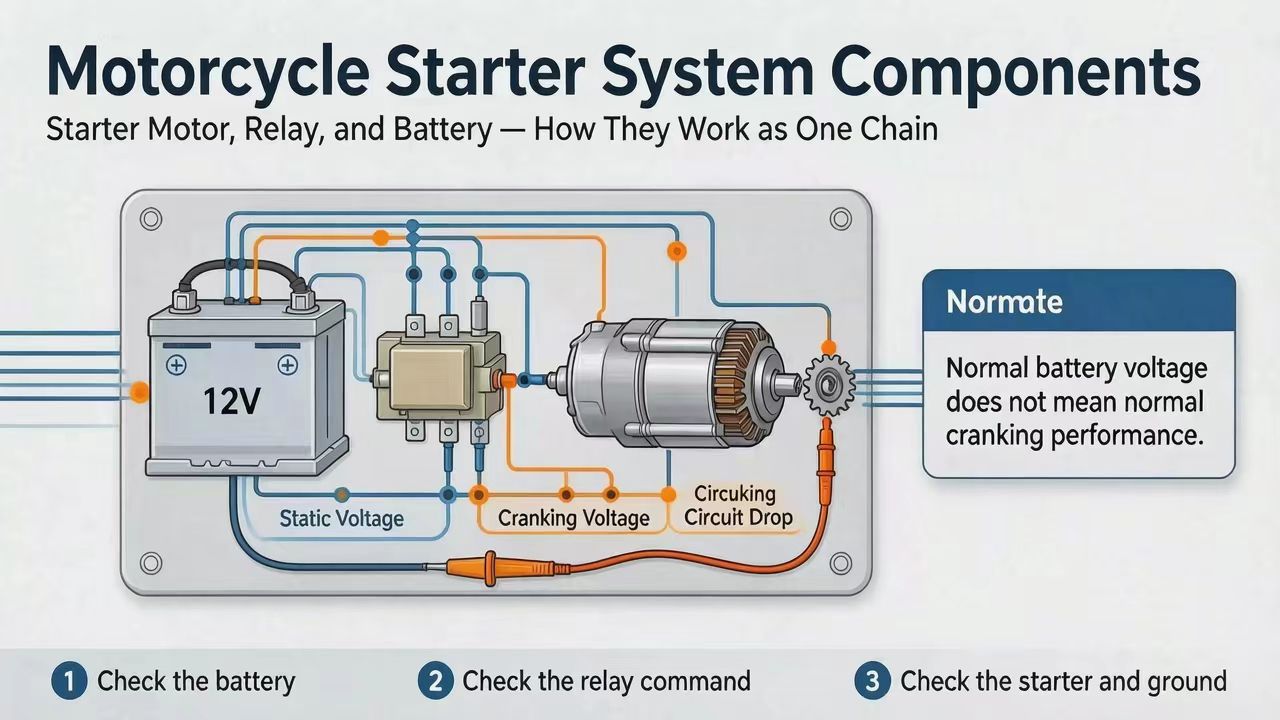
Short answer: the three parts are one chain. The battery delivers the current, the relay (solenoid) routes it and pushes the pinion into the ring gear, and the starter motor turns that current into torque to spin the crankshaft. The whole sequence takes well under a second. If any link fails, the engine does not crank. Many "starter is dead" diagnoses are actually a battery collapsing under load, a relay that never receives the command, or a poor ground that eats the voltage before it reaches the motor.
What does each component actually do?
It is a high-current circuit controlled by a small-current one.
| Component | Its job | Typical sign when it fails |
| Battery (12 V on most modern bikes) | Supplies the very high cranking current; also stabilises system voltage | Voltage holds at rest but drops sharply the moment the button is pressed |
| Starter relay / solenoid | A low-current signal closes its contacts; the solenoid then pushes the pinion into the ring gear | A click with no crank, or complete silence with no click at all |
| Starter motor | DC motor plus pinion and one-way clutch; turns electrical current into crankshaft rotation | Slow or laboured cranking, grinding noise, or a burnt smell after repeated attempts |
The relay is the part most often confused with the starter. It does two jobs at once: it closes the heavy contacts carrying current to the motor, and it drives the pinion forward. A click with no rotation therefore points to the contacts or the engagement side — not necessarily the motor.
What happens when you press the start button?
- The button sends a small signal. Your thumb closes a low-current control circuit through the ignition and the bike's safety interlocks (neutral, clutch and side-stand switches, depending on the model) — it never switches the cranking current itself.
- The relay coil energises. Its contacts close, connecting the battery to the motor through a short, thick cable.
- The solenoid throws the pinion. Before the motor spins, the pinion is pushed into mesh with the ring gear.
- Cranking current flows. The motor develops peak torque, the one-way clutch transmits it to the crankshaft, and the engine fires.
- You release the button. The relay opens and the pinion retracts; the one-way clutch then lets the engine overrun the starter without back-driving it.
Step 3 is why you should never hold the button after the engine catches: the pinion stays engaged and the starter can be spun far beyond its design speed.
Why does a battery that reads 12.6 V still fail to crank?
Here is the "many people think X, actually Y" case. Many riders think a battery that shows 12.6 V at rest is a good battery. In fact, a resting reading only shows surface charge — it says almost nothing about delivery under load. An ageing battery develops higher internal resistance: it still reads 12.6 V with everything off, then collapses when the starter asks for a burst of current. Forced to make the same torque at lower voltage, the motor draws more current, heats faster, and eventually burns its winding.
That is why a starter that "keeps burning out" is often a supply problem, not a bad part. The burn pattern can look identical to a genuine overload, so the starter gets blamed and replaced again.
Which component is at fault? Take three readings
A multimeter is enough to narrow this down. The figures below are general 12 V workshop references, not universal standards — confirm final limits in the bike's service manual.
| Reading | How to measure | General reference | What it points to |
| Static voltage | Engine off, all loads off, across the battery posts | Around 12.6 V at full charge; below roughly 12.4 V suggests discharge | Only rules out an obviously flat battery |
| Voltage during cranking | Meter on the battery posts, read the lowest point while cranking | Should generally stay above about 9.5 V | A steep drop points to high battery internal resistance |
| Circuit voltage drop | Crank while measuring battery positive to starter terminal, then starter case to battery negative | About 0.5 V total for the circuit; above roughly 0.2 V at any single point deserves attention | High readings point to cables, terminals or the ground path |
Interpretation: static voltage normal but cranking voltage collapses → battery. Both voltages normal but the drop high → cabling or ground. All three normal and still no crank → only then consider the starter.
The ground path is the most commonly skipped item. Many starters have no dedicated return wire; current flows through the case into the engine and back via a strap or the frame. That path carries the full cranking current, and corrosion or a loose bolt can consume a volt or more — a loss invisible when measuring at the battery posts.
How do you tell a bad relay from a bad starter?
Use the control terminal as the dividing line. Measure for voltage at the relay's start input while someone presses the button:
- Battery voltage present — the command has arrived. The fault is downstream: relay, solenoid, main cable or starter.
- 0 V — the command never arrived. Check the button, ignition switch, fuses and the safety interlocks.
- Voltage present but far below battery voltage — suspect a loose connection or a poor ground in the control side.
Then listen. A click but no rotation means the coil is energised — inspect the solenoid contacts and motor. Silence means look upstream. Relay failures are usually mundane (moisture, oxidised contacts, a burnt coil), and a relay is cheap to test by substitution before anyone removes the starter.
How long can you keep cranking?
A starter is a short-time-duty (S2) machine: enormous torque for a few seconds, then full cooling before the next attempt. It cannot run continuously. As general workshop experience, keep each attempt to about 5 seconds, leave roughly 15 seconds between tries, and stop after three or four failures to find the real cause — fuel, ignition, compression or supply.
A related misconception: fitting a larger starter does not fix hard starting. The unit is matched closely to peak cranking torque with little spare capacity; an oversized one can over-torque the ring gear or draw more current than the wiring was designed for.
When to stop and hand it over
Cranking tests involve a heavy, usually unfused cable and rotating parts. Disconnect the negative lead first, secure the machine, and never defeat a safety interlock or bridge the solenoid to "see if it works." Repeated burnout is a symptom to trace, not a part to keep replacing — low voltage, a bad ground or holding the button too long will kill one starter after another. Interlock logic, engagement geometry and voltage limits belong to the model's service manual, and electrical work should be done by a qualified technician.
Send us this before asking for a quote
If the starter itself is confirmed as the fault, or you are sourcing units for resale, send:
- Bike make, model, year and displacement, and whether starts are cold or warm.
- System voltage and the battery or charging setup actually fitted.
- Old unit details — part number, pinion tooth count, terminal style and a photo of the mounting face.
- Symptom history — silent, clicking, slow crank, or repeated burnout, and how many attempts it takes.
- Market and environment — road, off-road, coastal or high-temperature use.
- Annual quantity and required order interval.
Send those six items and we will confirm the matching unit, flag the interface or duty options your conditions call for, and state which production-lot test records we can supply — before you order.
Figures here are general experience values for 12 V starting systems, not universal standards. Confirm final selection and limits against the motorcycle's service manual and the supplier's data sheet.


Comments 0
Comments are moderated before publication. Please do not share personal or sensitive information.