
-
254
-
2025-10-21 15:59:32
What is a starter bendix? Learn about starter one-way clutch types, functions, maintenance tips, and model fits (Polaris Ranger/Can-am Outlander). Fix cold start issues & flywheel wear easily.
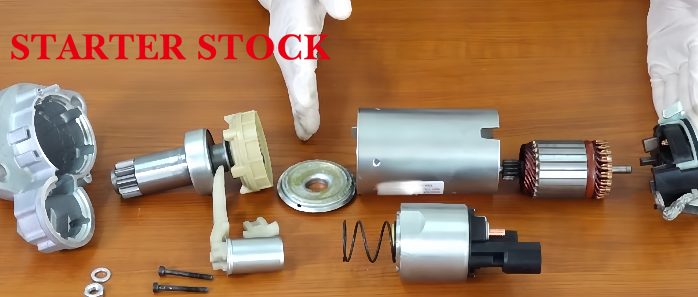
1. A brief introduction to the one-way clutch
1.1 The nickname of the one-way clutch
There are many names for one-way clutches for starter motors in the literature, such as one-way device, swing wheel, one-way clutch and drive gear, clutch assembly, one-way clutch and drive gear assembly, drive gear, transmission mechanism, one-way pulley clutch, one-way transcendence clutch, drive pinion, etc.The author believes that it is more appropriate to call it “one-way clutch and drive gear assembly”, and most of the literature is called “one-way clutch”, so this article also uses this name.
1.2 Composition and classification of one-way clutches
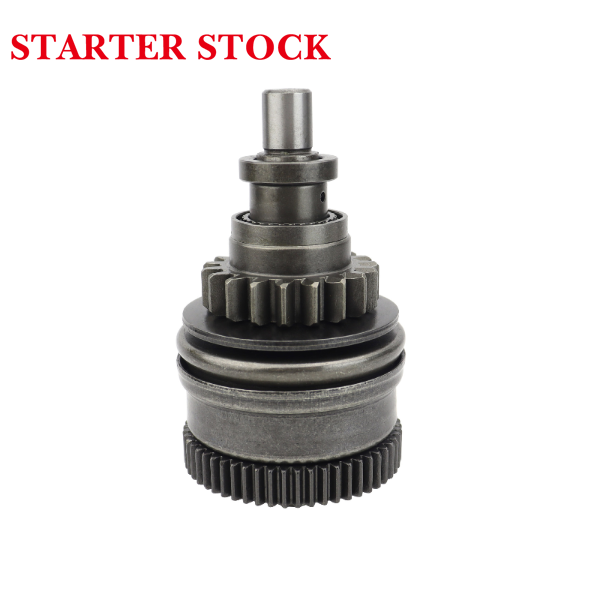
The one-way clutch consists of two parts: the drive gear and the clutch.According to the different internal structure of the clutch, the one-way clutch can be divided into three types: roller type one-way clutch, spring type one-way clutch, and friction plate type one-way clutch. Their appearance and function are the same.The drive gear and clutch form an integral part, which cannot be disassembled and repaired under normal circumstances.
1.3 What Does a Starter Bendix (One-Way Clutch) Do?
At start-up, the one-way clutch will engage with the flywheel ring gear of the engine, and transmit torque to drive the engine to rotate at high speed, and finally make the engine start and run smoothly; after the start-up is over, the one-way clutch will be out of contact with the flywheel ring gear of the engine.
Common situations of automatic start failure: When you turn the car key to start the vehicle, if the starter idles but the engine fails to start, there is a high probability that the one-way clutch has slipped. Common causes include internal roller wear or spring failure.
This issue is more common in cold start issues (low-temperature environments), as the lubricating grease in the one-way clutch may solidify, causing the rollers to get stuck and unable to transmit torque.
Safety protection mechanism:After the engine starts, the one-way device is automatically separated to avoid the flywheel from dragging the starter and extend the life of the motor. If the separation is delayed, it may lead to abnormal noise or even damage to the starter—this is often related to flywheel ring gear wear (excessive wear on the flywheel teeth prevents the one-way clutch gear from disengaging smoothly).
1.4 The operating principle of the one-way clutch
When starting, the electric electromagnetic switch (solenoid switch) generates magnetic force, and the core of the electromagnetic switch (solenoid switch) is displaced. This causes the fork (shift fork) to act, rotating the one-way clutch along the electric pivot (armature shaft) and pushing it out. When the gears of the one-way clutch are engaged with the engine flywheel ring gear, the motor transmits the torque generated to the engine through the electric pivot.The engine then rotates at high speed, thereby achieving normal start-up and operation.
After the start-up process is over, the electromagnetic switch (solenoid switch) will be powered off and lose its magnetic force.At this time, the fork (shift fork) is reset, and the centrifugal force of the one-way clutch itself will pull it back into place, causing it to be out of contact with the engine flywheel ring gear.After that, the one-way clutch remains in the state to be started, waiting for the next start signal-in this process, the smooth rotation of the armature is the key to avoid stagnation.
1.5 2 common parameters of one-way clutch
There are two common parameters of one-way clutches, one is the number of teeth of the drive gear, and the other is the number of keys of the one-way clutch (that is, the number of sliding keys on the armature). Generally, it is marked on the packaging box of the product, which is conducive to selection. The form is: Number of teeth × number of keys.
1.6 Industry standards and core performance indicators
Unidirectional devices need to comply with a number of industry specifications, such as:
According to JB/T 6705-2006: It is stipulated that the unidirectional device for motor vehicles must work stably at -40℃~130℃, the gear accuracy is not lower than level 9, and the tooth surface hardness is 58-63HRC.;
For details, please refer to the relevant content released by the China Construction Machinery Industry Association:https://www.chinesestandard.net/PDF/English.aspx/JBT6705-2006
According to JB/T 14611-2023: For unidirectional devices of agricultural and forestry machinery, the rated torque is ≥35N・m, the idling speed is ≥3000r/min, and the performance attenuation does not exceed 10% after the durability test.
Extension of technical parameters:Standard bushing gap: The standard gap between the armature and the bushing is 0.03~0.09mm, and it needs to be replaced if it exceeds 0.23mm, otherwise it will easily cause abnormal meshing noise. This noise may also be a warning sign of flywheel ring gear wear—if the flywheel teeth are worn or chipped, the one-way clutch gear will collide with them during engagement, producing a "clicking" sound.
Suitable for spline matching: The common number of keys is 3, 4, and 6 keys, which must be exactly in line with the starter motor (for example, Polaris Ranger is mostly designed with 6 keys). For models prone to cold start issues (such as off-road vehicles used in alpine areas), it is recommended to choose one-way clutches with larger keyway contact areas to improve torque transmission stability in low temperatures.
1.7 Typical model applications
Different models have significant differences in the parameter requirements of the unidirectional device:
Suitable for Polaris Ranger (UTV): More roller-type unidirectional devices with 11×6 teeth×keys are used to meet the needs of high torque start-up.;
Suitable for Bombardier Outlander 400: It needs to match a specific spline size (such as an inner diameter of φ12.015mm), and the meshing gap between the gear and the flywheel needs to be checked during installation.
2.What are the three forms of common starter one-way clutches?
●Roller type one-way clutch
This clutch uses the movement of the roller in the wedge-shaped groove to achieve one-way locking.When the starter is driven, the roller is wedged into the groove, so that the gear and the flywheel ring gear are closely engaged.Once the engine starts, the roller exits from the wedge-shaped groove to prevent reverse drive.This design is simple and reliable, and is widely used in a variety of car models.
●Friction plate one-way clutch
The friction plate clutch realizes one-way transmission through the compression and release of multiple layers of friction plates.During the start-up process, the friction plate is pressed to transmit torque; after the engine starts, the friction plate is released to prevent reverse torque transmission.This clutch can withstand large torque and is suitable for high-power engines.
●Ratchet one-way clutch
With the help of the meshing effect of the ratchet and the pawl, the ratchet clutch can achieve one-way power transmission.When the starter is working, the pawl will snap into the ratchet cogging and transmit torque; after the engine is started, the pawl will be separated from the ratchet to avoid reverse drive.Its structural design is relatively compact, but the torque scale it can withstand is relatively limited, so it is more suitable for small and medium-power engine types.
Roller type one-way clutch:
This type of clutch relies on the position change of the roller in the wedge groove to achieve one-way locking and transmission.When the starter is powered on and running, the motor drives the outer seat ring of the clutch to rotate, and the roller is squeezed into the narrow end of the wedge-shaped groove under the action of centrifugal force and friction, so that the inner and outer seat rings are locked into one, and then the drive gear is driven to engage with the engine flywheel ring gear to transmit torque; after the engine starts, the flywheel speed exceeds the starter, and the roller slides down to the wide end of the wedge-shaped groove under the action of reverse friction, and the inner and outer seat rings are separated to avoid the engine from driving the starter in reverse.Its simple structure, high reliability, and low cost are widely used in the starter motors of most small and medium-sized vehicles such as family cars and light trucks.
Friction disc type one-way clutch:
It completes the one-way torque transfer through the compression and release of multi-layer friction plates.When starting, the compression mechanism inside the starter will compress the friction plate group, so that the power is transmitted from the active end to the driven end, and the drive gear is driven to engage with the flywheel ring gear; after the engine starts, the compression mechanism is relaxed, the friction plate group is separated, and the power transmission is cut off.This type of clutch can withstand large torque, and the transmission process is stable and the impact is small. It is suitable for heavy trucks, construction vehicles, large SUVs and other models equipped with high-power engines. It is also commonly used in some special vehicle starter engines with high torque requirements.
The characteristics of the ratchet clutch will be explained again.
The ratchet clutch relies on the meshing of the ratchet and the pawl to complete the one-way transmission.When the starter is started and running, the pawl is stuck into the ratchet cogging under the action of a spring or other reset mechanism, which transmits the power of the starter to the drive gear, and then drives the engine flywheel to rotate; when the engine is successfully started and the speed exceeds the starter, the ratchet will push the pawl out of the cogging under the reverse force, terminating the power transmission, preventing the engine from reverse driving the starter and causing damage to the components.
From the point of view of structure and performance, the advantage of ratchet clutch is that it is compact in size and compact in structure, and can adapt to installation scenarios with limited space; however, it is limited by the way the pawl engages with the ratchet, and the maximum torque it can withstand is relatively small, so it is more suitable for small and medium-sized engines, such as small family cars, motorcycles, small agricultural machinery, minivans, etc. Equipment or vehicles with low torque requirements.
For auto repair and maintenance professionals, understanding the structures, characteristics, and model compatibility of these three starter one-way clutches is critical. Choosing a clutch that matches your vehicle (e.g., 11×6 roller-type for Polaris Ranger) and performing regular maintenance (like applying low-temperature grease) not only ensures the starting system runs reliably and efficiently but also reduces startup-related wear and extends the vehicle’s overall service life.
3.Basic maintenance tips for one-way clutches:

●To avoid cold start issues, Step 1: apply low-temperature resistant lithium-based grease to the armature shaft and bushing every 20,000 kilometers—this prevents grease solidification in -40℃ environments.
●Regularly check the flywheel ring gear for flywheel ring gear wear (visually inspect for tooth cracks or excessive wear). If found, replace the flywheel in time to avoid secondary damage to the one-way clutch gear.
●When the starter makes abnormal noise during startup, first check the electromagnetic switch (solenoid switch) for loose wiring, then test the one-way clutch's locking function—this helps quickly locate the fault without disassembling the entire starter.
For the fault diagnosis and replacement steps of the unidirectional device, please refer to "how to test a starter bendix?"》 "how to change bendix on starter?""and other articles.
The life span of different types of unidirectional devices varies greatly (for example, the life span of the friction disc type can reach more than 50,000 times). For details, please check "what causes a starter bendix to go bad?"》