
-
100
-
2025-10-29 09:21:23
How to test ignition coil
How to test the ignition coil for ships? Explain different styles in one article

1、First of all, understand: if the ignition coil is broken, what "abnormal signal" will the ship have?
Don't rush to disassemble the parts, first check the performance of the machine. If your ship experiences these situations, it is highly likely that there is a problem with the ignition coil. Take a note and compare it:
Difficulty starting: In the past, it only took two or three strokes to start, but now it has been pulled more than ten times without any response, or after finally starting, the engine stalls as soon as the throttle is released;
Idle trembling: The engine runs unevenly, as if shivering from a cold, and the pointer on the dashboard (if any) fluctuates up and down;
Acceleration is not strong: When driving, I want to speed up, but I have been holding the accelerator for a long time without any response. The boat runs slowly, slower than usual;
Exhaust 'not right': The exhaust pipe emits black smoke with a burnt smell, or the sound becomes particularly muffled, different from usual;
Sudden 'strike': Running suddenly stalls, and there is no response when restarted, especially after being bumpy in the water.
These signals are like machines shouting for help. If you find them, don't force them on. Check the ignition coil first, otherwise it may damage other parts as well.
2、Detecting ignition coil: It can be done in 4 steps without the need for complex tools
Detection can be divided into "rough check" and "fine check". Beginners should start with a rough check, and most minor issues can be identified; If there are no issues with a rough check, then use the tool to conduct a closer inspection.
Step 1: First "look" - whether there is any obvious damage
Remove the outer casing of the outboard motor (usually by tightening a few screws) and locate the ignition coil - usually a black square or cylinder with several colored wires (high-voltage wires) connected to it, one end connected to a spark plug and the other end connected to the interior of the engine.
Check the shell: Are there any cracks or deformations? Especially in the corners and wiring areas, damp weather can easily cause water to enter through cracks, leading to internal short circuits;
Check the wires: Are the connected wires aging or peeling? Is there rust or looseness at the joint? For example, if the "hat" that connects to the spark plug is loose, it will have poor contact;
Check for oil stains: Is there any oil or fuel leakage on the surface of the coil? Oil stains can affect heat dissipation and burn the coil over time.
For example, when I was helping a friend repair a boat before, I opened it and found a crack in the ignition coil casing, and there was a bit of mold inside - this is a typical case of water damage. Just replace it and there's no need to test it again.
Step 2: Touch again - feel the temperature and looseness
Start the engine (if possible), let it idle for 5 minutes, then turn it off. Gently touch the surface of the ignition coil with the back of your hand (be careful not to burn your hands, a temperature of about 40-60 ℃ is normal):
Touch temperature: If a certain part is particularly hot, such as exceeding 70 ℃ locally, or feels cold to the touch (other parts have temperature), it indicates that there may be a short circuit or open circuit inside the coil;
Feeling Loose: Gently shake the coil and wiring with your hand, do you feel any shaking? If there is obvious shaking, it may be due to loose fixing screws or internal parts falling off, which need to be tightened or disassembled for inspection.
Here's a reminder: never touch with your palm, as high temperatures can cause burns. The skin on the back of your hand is thin and more sensitive to temperature, making it safer.
Step 3: Simple "Test" - Use a multimeter to check for continuity (even beginners can learn)
If you don't find any problems after looking and touching, just use a multimeter to test it. The tool is not expensive, you can buy one for a few tens of yuan, and the operation is very simple:
First, turn off the power: turn the engine's shutdown switch to "OFF", unplug the power cord (usually a thin red or black wire) of the ignition coil to avoid electric shock;
Gear adjustment: Turn the knob of the multimeter to the "Ohm" position (symbol Ω), select the "200 Ω" or "2000 Ω" position (depending on the coil model, usually refer to the manual, if there is no manual, select 2000 Ω);
Test the "primary coil": Find the "primary terminal" on the ignition coil (the two small screws that connect the power cord), place the two probes of the multimeter on these two screws respectively, and look at the numbers on the display screen:
Normal value: The primary resistance of a typical marine ignition coil is 0.5-2 Ω. If it exceeds 3 Ω, the resistance is too high and may be due to a broken wire; A value below 0.3 Ω indicates a short circuit and requires repair or replacement;
Measure the "secondary coil": Find the "high voltage terminal" (usually a large screw connected to a thick wire) that is connected to the high voltage wire, place one probe on the high voltage terminal and the other probe on the "ground terminal" of the primary terminal (usually the screw connected to the black wire), and check the values:
Normal value: The secondary resistance is generally 10-20k Ω (1k Ω=1000 Ω). If it displays "OL" (indicating open circuit), it means that the coil is internally broken; If it is below 5k Ω, it is a short circuit and cannot be used anymore.
For example, last time we tested the coil of a two-stroke outboard motor, the primary resistance was 1.2 Ω (normal), and the secondary resistance displayed "OL", indicating that the secondary coil was broken. We replaced it with a new one and it immediately started up normally.
Step 4: "Substitution Method" - the most direct way of judgment
If you have a spare ignition coil in hand or can borrow the same model, the "replacement method" is the most convenient: remove the suspected faulty coil, install the spare one, and then start the engine——
If all the previous problems disappear after replacement, it means that the original coil must be broken;
If it still looks the same after replacement, it's a problem with other parts (such as spark plugs, carburetors), and you don't need to focus on the coils anymore.
This method is particularly suitable for beginners. They don't need to understand the principle, as long as they can unscrew screws and connect wires. The only drawback is that they need spare parts.
3、Different types of marine ignition coils: their characteristics and usage are completely different
Marine ignition coils are not a one size fits all solution. Engines with different displacements and cylinder numbers are equipped with different coils, and if used incorrectly, they not only fail to start, but also burn the machine. Here are the three most common types, remember not to buy the wrong one.
1.Single cylinder outboard motor dedicated: "compact", suitable for small horsepower boats
This type of coil is most common, for example, in two-stroke outboard engines with less than 15 horsepower (such as those commonly used in hanging engines and rubber boats), there is usually only one ignition coil, which is not large in size, about the size of a fist, and is usually fixed on the cylinder head of the engine.
Features: Simple structure, only one set of primary coils and one set of secondary coils, few wiring (usually three wires: power line, grounding line, high-voltage wire), cheap price, ranging from tens to hundreds of yuan per wire;
Usage note:
Don't change the voltage randomly: This type of coil is usually 12V, and the battery on the ship is also 12V. Do not connect it to a 24V power source, as it will burn out immediately;
Waterproof should be done well: Small horsepower boats are often used in shallow water areas or on the shore, which can easily splash water. When installing, the wiring of the coil should be wrapped with waterproof tape to avoid water ingress;
Common problem: Due to its simple structure, the most common problem is "loose high-voltage wire joints". Sometimes it's not the coil that's broken, it's just the joint that's loose. Simply re insert it and wrap it with tape.
For example, I once helped someone repair the engine of a rubber boat, thinking that the coil was broken. When I removed it, I found that the connector of the high-voltage wire had fallen off. I plugged it back in and wrapped it with waterproof tape, and it started immediately, saving me money on replacement parts.
2.Special for multi cylinder outboard engines: "team style", suitable for high-powered yachts
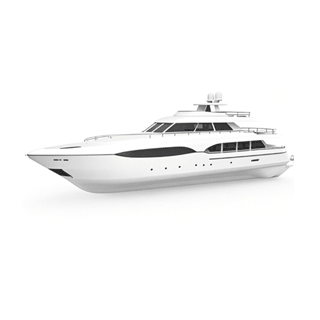
A high-powered boat (such as a four stroke yacht with over 30 horsepower) typically has a 2-cylinder or 4-cylinder engine, and the corresponding ignition coil is a "multi cylinder model" - either several independent coils are assembled together (called a "coil group"), or multiple sets of coils are installed in one shell (called an "integrated coil").
Features: Each set of coils corresponds to one cylinder, for example, a 4-cylinder engine has 4 sets of coils, with multiple wiring connections (in addition to power and ground wires, there are also signal wires for connecting to the engine computer), large size, and high price, ranging from a few hundred to thousands of yuan;
Usage note:
Do not install in reverse order: Each group of coils corresponds to a fixed cylinder, for example, cylinder 1 corresponds to coil 1, and cylinder 2 corresponds to coil 2. Installing them in reverse will result in the "wrong ignition sequence", and the engine will either fail to start or run violently shaking;
When testing, it is necessary to "check one by one": if only one cylinder of the engine is not working, there is no need to replace all the coils, just test the corresponding set of coils. For example, if one cylinder of a 4-cylinder engine is not working, test the first coil, and do not move the other coils;
Don't touch the signal line: This type of coil has a signal line connected to the engine computer, which is very thin. When disassembling, don't pull it hard. If it breaks, it will be difficult to repair, and it also needs to match the computer data.
For example, once I was repairing a 4-cylinder yacht engine and it was shaking at idle speed. After testing, it was found that the second coil was broken. Only the second coil was replaced, and the other three were left untouched. This not only saves money but also saves effort. If you don't know how to replace the entire set randomly, it will be a waste of money.
3.Waterproof enhanced version: "Durable", suitable for sea fishing boats and fishing boats
Sea fishing boats and fishing vessels often run on the sea, exposed to wind, sun, and seawater corrosion. Ordinary coils will not last long, so "waterproof reinforced" ignition coils need to be used.
Features: The shell is made of waterproof material (such as plastic or rubber that is resistant to seawater), and there is a "waterproof plug" (not a regular plug, it has a sealing ring) at the connection point. There is also a moisture-proof coating inside, which can withstand seawater immersion and high temperatures. The price is slightly higher than the ordinary model, but it is durable;
Usage note:
Don't lose the waterproof sealing ring: The waterproof sealing ring in the plug is very small and easy to fall off when removed. If it is lost, it will no longer be waterproof. It is best to put it in a small box when removed and put it back in when installed;
Regularly clean the salt: Every time you come back from going out to sea, rinse the exterior of the engine, including the ignition coil, with water to remove the surface salt, otherwise the salt will corrode for a long time, and even the most durable coil will be damaged;
Don't use regular coils instead: Some people use regular coils instead of waterproof ones to save money, but they break down in less than a month or two, instead spending more money. It's better to buy the right one from the beginning.
For example, I know a sea fishing master who uses waterproof reinforced coils on his boat and has been using them for 3 years without any damage, while he used regular coils before and had to replace them every six months, which is actually more cost-effective.
4.Finally, a reminder: The 3 easiest mistakes to make, don't fall into the trap
Don't judge based on intuition: Some people think that "if the coil is hot, it's broken", but in fact, normally running coils will naturally heat up. As long as it doesn't exceed 70 ℃ and there is no odor, there is no problem. Just remove and replace it if you don't move it;
Don't use "inferior substitutes": There are some cheap coils online, costing tens of yuan each, which look like genuine products. In fact, the copper wire inside is thin and the insulation layer is thin, and it will burn out in no time. It may also damage the engine and computer. Try to buy original or big brand accessories, although they are more expensive, they are worry free;
Remember clearly before dismantling: When dismantling the coil, take a photo first and remember which wire is connected to which connector, especially for multi cylinder coils, which have multiple connections and cannot be installed in the wrong order. Take a photo to compare the clothing and avoid mistakes.
In fact, the ignition coil is not so "mysterious". As long as you master the method of "looking, touching, and testing", and distinguish which type of ship you use, most problems can be solved by yourself, without having to find a repairman every time. It saves money and allows you to understand your own ship. If you don't know which type of coil to use for your ship, or if you can't understand the values when measuring, you can also tell me the model of the engine (usually on the engine casing), and I will help you analyze it.
If you have any questions that you don't understand, you can leave a comment in the comment section. Welcome to discuss together:)