
-
81
-
2025-11-06 15:53:41
When it comes to motors, you might think of the motor spinning your home fan or the complex components inside a car engine. But today's topic, the “stepper motor,” is the precision control master of the motor family. Unlike ordinary motors that spin wildly once powered on, it moves step by step with steady precision. Every rotation angle is meticulously controlled, making it seem like a perfectionist walking with a ruler. Next, let's explore what makes this' little motor 'special.
How does a stepper motor operate?
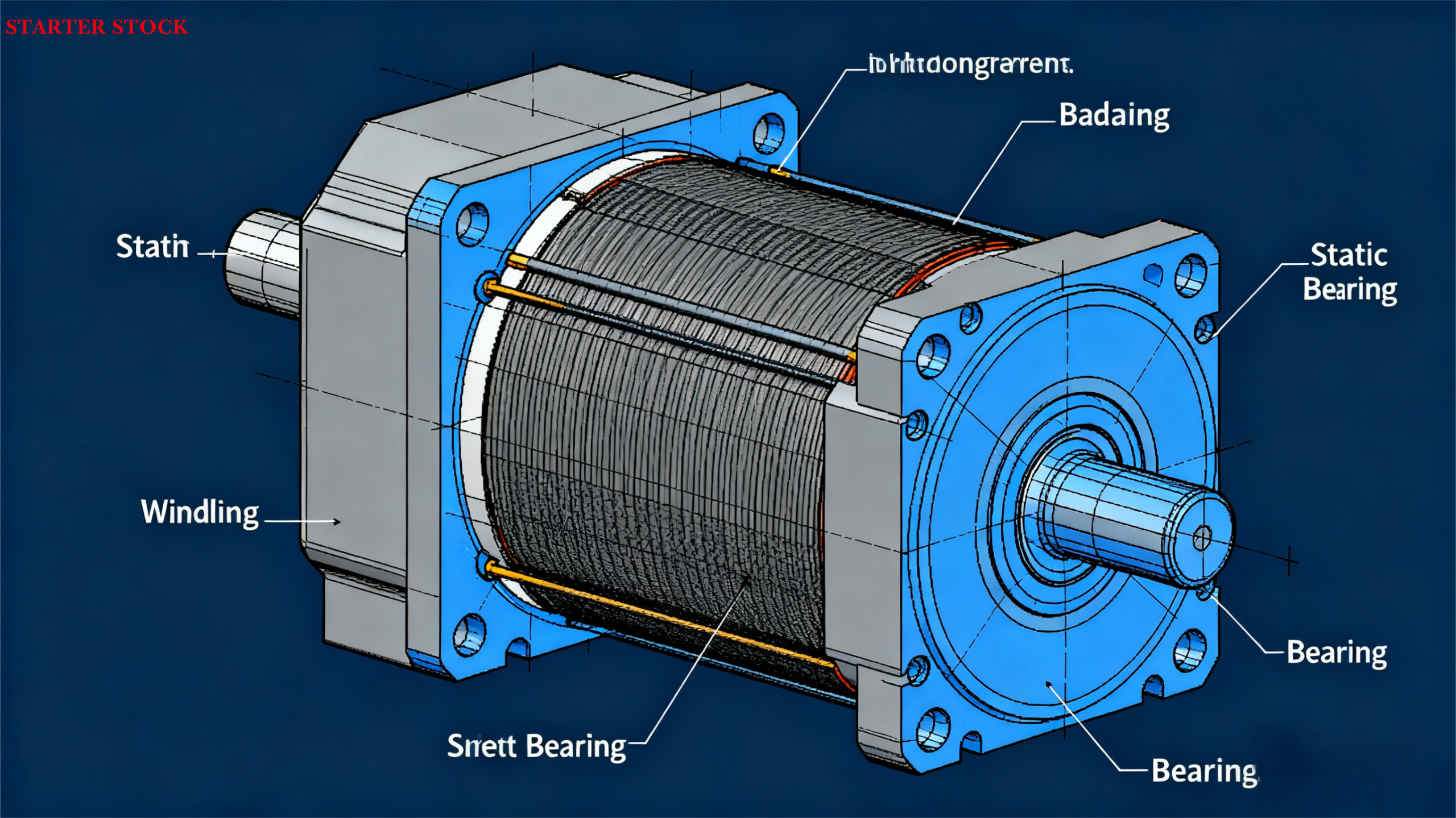
Its working principle resembles magnetic building blocks. It consists of two key parts: a stationary “stator” with coils that become electromagnets when energized, and a rotating “rotor” made of permanent magnets with built-in north and south poles.
Types of Stepper Motors
While stepper motors all follow a “precision path,” they actually come in different types, much like bubble tea has various toppings like pearls, coconut jelly, or taro balls. Each type suits different scenarios:
● Permanent Magnet Stepper Motors: The most common “entry-level” type, featuring a rotor made of permanent magnets. They boast a simple structure and low cost—think of the small motors in printers that move the print head. The downside is limited torque and restricted maximum speed.
● Induction Stepper Motors: The rotor is made of soft iron with no magnetic properties, relying entirely on the magnetic force from the stator coils to “push and pull” it into rotation. Advantages include small step sizes (enabling finer movement) and high rotational speeds. Examples include small motors in precision instruments. However, the drawbacks are significant: they require high current and lack “holding force” when power is cut, making them prone to “drift.”
● Hybrid Stepper Motor: A hybrid of the previous two types, combining the holding force of permanent magnet rotors with the precision of reactive motors. It offers high torque, high accuracy, and respectable speed. Widely used in modern equipment like 3D printers and CNC machines, its only minor drawback is a slightly higher price compared to the other two types—though it remains highly cost-effective.
Why the Preference for Stepper Motors?
If motors were employees, stepper motors would be the dependable ones. Their key features make them indispensable in many applications:
First, their high precision. Each step corresponds to a fixed angular displacement. By controlling the “number of steps,” precise positioning is achieved. For example, in 3D printers, the motor's step count directly determines the extrusion length in millimeters—with zero deviation. Similarly, in camera lens focusing, stepper motors slowly move the lens elements to ensure sharp images.
Second, they offer simple control. No complex sensors are needed—just feed them a “pulse signal” (equivalent to a “move X steps” command), and they execute obediently. Take smart curtains at home: when the motor receives a “move 100 steps” command, it pulls the curtain the specified distance without requiring constant supervision.
They also maintain position during power loss. When de-energized, the rotor is often “held” by the stator's magnetic force, preventing unintended rotation. For instance, during CNC machining, pausing the motor keeps the cutting tool precisely positioned, preserving machining accuracy.
Of course, it has minor drawbacks. For instance, its force diminishes during high-speed rotation (similar to how a person running too fast loses strength to lift objects), and it may produce slight vibrations during operation. However, most of these issues can be addressed through technical solutions, leaving its “reliable reputation” largely unaffected.
Where are stepper motors applied?
In fact, stepper motors are ubiquitous in our daily lives, though often unnoticed:
● Household appliances: The “lid-opening motor” in smart rice cookers uses stepper motors to precisely control the opening angle; air conditioner “air deflectors” that slowly rotate left/right and up/down to adjust airflow direction; and microwave “turntable motors” that gently rotate food for even heating.
● Digital devices: “Lens focusing motors” in smartphone cameras use stepper motors to fine-tune lens positioning for sharper photos; In printers and scanners, stepper motors drive paper rollers to control feeding speed and positioning.
● Industrial equipment: 3D printer “extruder motors” and “nozzle motors” rely on stepper motors for precise material extrusion and nozzle movement; CNC machine tool “cutting tool motors” guide tools step-by-step to machine parts with 0.01mm precision; Additionally, “conveyor belt motors” in automated production lines regulate belt travel distance to ensure precise part placement.
● Other applications: Medical devices like “infusion pumps” use stepper motors to control medication drip rates per hour; robotic “joint motors” gradually rotate mechanical arms to perform grasping, lifting, and other motions.
How to choose the right stepper motor?
Selecting a stepper motor doesn't have to be complicated—just remember a few key parameters:
First, check the step angle, which is the angle rotated per step (e.g., 1.8 degrees or 0.9 degrees). A smaller step angle enables finer rotation, ideal for applications requiring precise positioning (like 3D printers). Motors with larger step angles suit applications requiring high speed but lower precision (e.g., curtain motors).
Next, consider torque—the motor's “strength,” measured in Newton-meters (N·m). For instance, driving heavy curtains requires a motor with higher torque, while camera lens focusing only needs low torque.
Also check voltage and current requirements, as different motors need different power levels. These must match the drive circuitry; otherwise, you risk “burning out the motor” or “stalling it.”
Finally, consider mounting dimensions like motor diameter and length, which must fit the device's “space constraints.” You wouldn't cram a large motor into a compact camera, after all.
In essence, stepper motors function as “precise and obedient little helpers.” Though compact in size, they deliver significant performance in applications demanding “stability, accuracy, and precision.” Next time you use a printer or smart curtains, consider this: a stepper motor might be quietly at work inside!