
-
114
-
2025-11-19 13:44:53
The drive motor system is one of the three core systems in electric vehicles, serving as the primary propulsion system for vehicle operation. Its characteristics determine key vehicle performance metrics, directly impacting power delivery, fuel efficiency, and the user's driving experience.
The drive motor serves as the power core of new energy vehicles, tasked with both propelling the vehicle forward and recovering energy. Given the compact structure, high speed, and extended range requirements of new energy vehicles, fundamental design criteria for drive motors include: high-density lightweight construction, high efficiency, energy recovery capability, high reliability and safety, and the potential for continuous cost reduction.
New energy vehicle motors are categorized into DC motors, asynchronous motors, permanent magnet synchronous motors, and switched reluctance motors.
This article focuses on permanent magnet synchronous motors (PMSMs). PMSMs replace the rotor excitation windings of separately excited synchronous motors with permanent magnets, which are embedded within the rotor to form synchronously rotating magnetic poles.
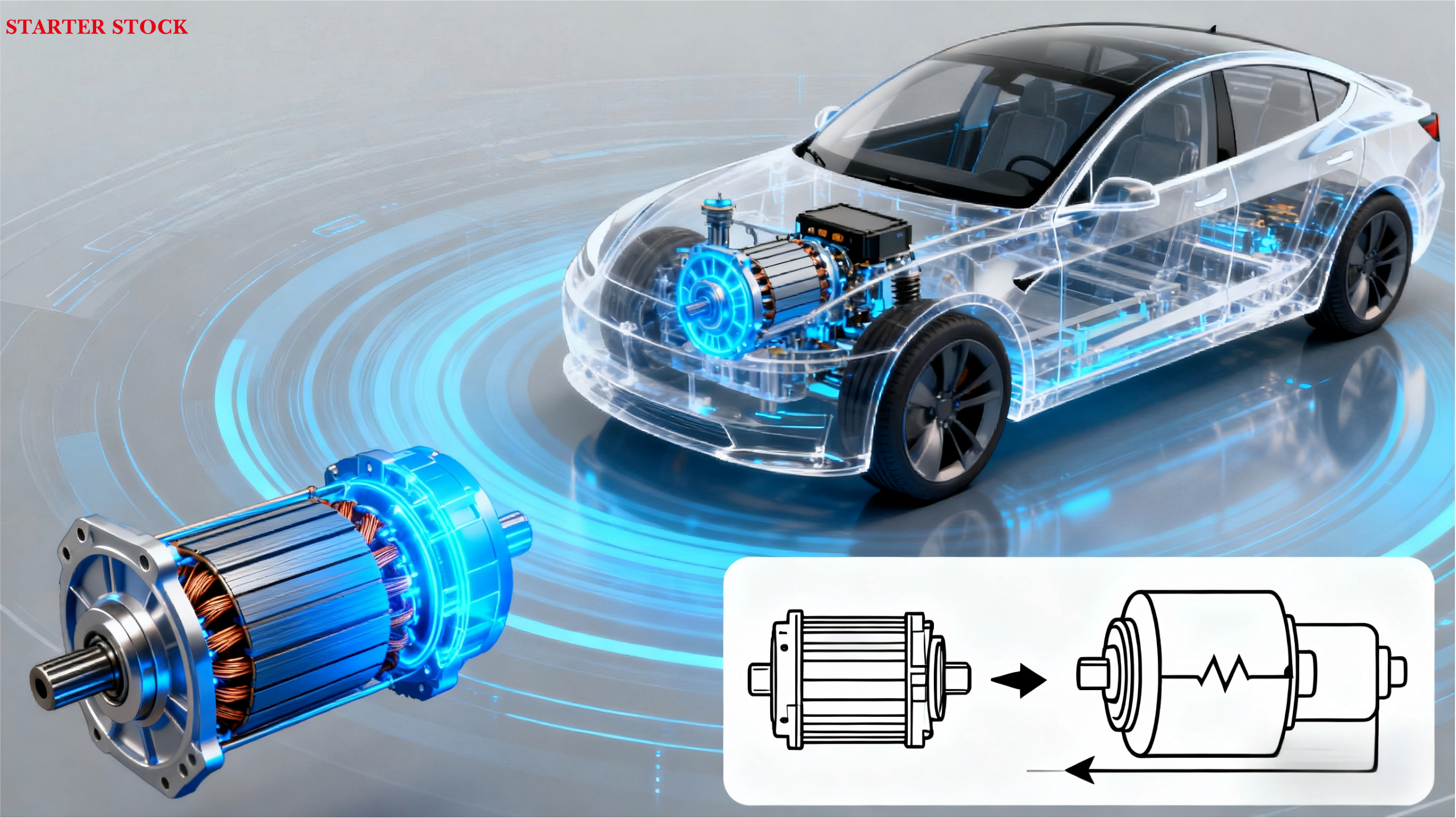
Working Principle:
Startup and operation are achieved through the interaction of magnetic fields generated by the stator windings, rotor squirrel-cage windings, and permanent magnets. This is currently the most widely used motor type.
Some cars on the market now use permanent magnet synchronous motors as the core, aiming to achieve high efficiency, high performance, and sustainability. This advanced motor achieves a perfect balance between power and efficiency while maintaining a compact and lightweight design. Unlike traditional induction motors, permanent magnet synchronous motors embed strong permanent magnets in the rotor to generate a magnetic field without the need for external current. When the stator surrounds the rotor and is energized, a rotating magnetic field is formed to drive the rotor to rotate accurately and synchronously. This achieves smooth acceleration, instantaneous torque output, and a nearly silent operating experience. This type of feature is precisely the core advantage of electric vehicles.
Permanent magnet synchronous motors have high torque output capability in a stationary state, perfectly suited for urban commuting and high-speed cruising scenarios. In addition, the compact design of the motor optimizes weight distribution and interior space distribution.
New energy vehicles use electric drive systems to convert the electrical energy stored in high-voltage batteries into mechanical energy, generating propulsion to drive the vehicle. At present, the driving methods used in electric vehicles are divided into centralized driving and wheel independent driving.
(1) Centralized Drive
Centralized drive refers to a vehicle utilizing one or two power sources (hybrid vehicles), typically an engine and an electric motor, positioned strategically within the vehicle. Through a transmission and reduction gearbox that lowers speed and increases torque, it can adopt front-wheel drive, rear-wheel drive, or all-wheel drive configurations.
For pure electric vehicles, centralized drive systems currently feature three primary structural configurations: traditional drive systems, motor-drive axle combination drive systems, and integrated motor-drive axle drive systems.
(2) Independent Wheel Drive
The independent wheel drive system for electric vehicles utilizes multiple independently controlled motors to drive each wheel individually, known as hub motors. This eliminates the need for a mechanical transmission system, instead converting electrical energy into mechanical drive energy for each wheel through electronic conduction.
Currently, there are two primary typical configurations for independent wheel drive layouts: dual-motor drive and hub motor drive.
Key Technologies for Drive Motors
Core technologies in electric drive systems encompass motor design, motor controllers, control algorithms, sensors, and electronic components. This article explores key advancements in drive motors through two aspects: flat-wire motors and oil-cooling technology.
(1) Flat-Wire Motors
Compared to traditional round-wire motors, flat-wire motors achieve a 20%-30% increase in bare copper slot fill rate, a 21% reduction in copper losses, and a 1% improvement in efficiency. The increased slot fill rate enables the motor to deliver higher power and torque within the same volume, or to reduce the motor's outer diameter and volume while maintaining the same power output, thereby decreasing the motor's weight. Consequently, flat-wire wound motors offer higher power density.
Schematic Diagram of Flat-Wire Motor Winding Method
(2) Oil Cooling Technology
Three commonly used motor cooling systems: air cooling, liquid cooling, evaporative cooling, and enhanced thermal path cooling systems.
Air-cooled system: Low cost, high reliability, and easy installation.
Liquid-cooled system: High heat dissipation capacity, suitable for applications with significant motor heat generation and high heat flux density.
Evaporative cooling system: Primarily used in megawatt-class large-capacity generator sets, achieving efficient motor cooling through vapor-liquid phase change cycles.
Permanent magnet synchronous motors generate significant heat at the winding ends. While water cooling prevents direct contact with windings, oil cooling enables direct contact, delivering superior cooling efficiency and distinct advantages.
Oil cooling technology allows direct contact between cooling oil and motor heat-generating components, achieving far higher heat dissipation efficiency than traditional water cooling systems. Additionally, the oil medium offers advantages including excellent insulation, high dielectric constant, low freezing point, and high boiling point.