
-
89
-
2025-12-31 17:06:30
Table of Contents:
That Noise in the Morning: Your Car's Alarm Clock
Cracking It Open: What You Actually Find Inside
The Two-Second Miracle (And How It Usually Works)
Not Just for Sedans: Starters in the Wild
Learning Its Language: What a Dying Starter Sounds Like
Why They Quit: The Real Reasons
The Bench Doesn't Lie: My Favorite Test
The Eternal Question: Fix It or Chuck It?
The Parts Problem Nobody Talks About
How I Finally Solved My Sourcing Headaches
Parting Thoughts: Give the Thing Some Respect
1. That Noise in the Morning: Your Car's Alarm Clock
Okay, let's get real for a second. You know that sound, right? The one that's a mix of a grinding coffee mill and a determined robot? Ruh-ruh-ruh-ruh-VROOM. That's the sound of something winning a fight. The engine is the heavy sleeper, full of compression and inertia, and the starting motor—or just "the starter"—is the thing that kicks it out of bed.
I've been a mechanic for more years than I care to count. In all that time, I've learned that the starter is the ultimate gatekeeper. It's the handshake between the silent, digital world of your battery and the violent, mechanical world of combustion. Without it, you've got a very expensive paperweight. It doesn't care about fuel mixtures or spark timing. Its entire existence is about one brutal, beautiful task: taking a slug of electricity and using it to spin several hundred pounds of metal fast enough to wake it up.
Think of it this way: an engine running is a self-sustaining reaction. But an engine at rest? It's just a cold assembly of parts. The starter is the primer. It's the first push on the swing. And when it decides it's had enough, your day is officially ruined.

2. Cracking It Open: What You Actually Find Inside
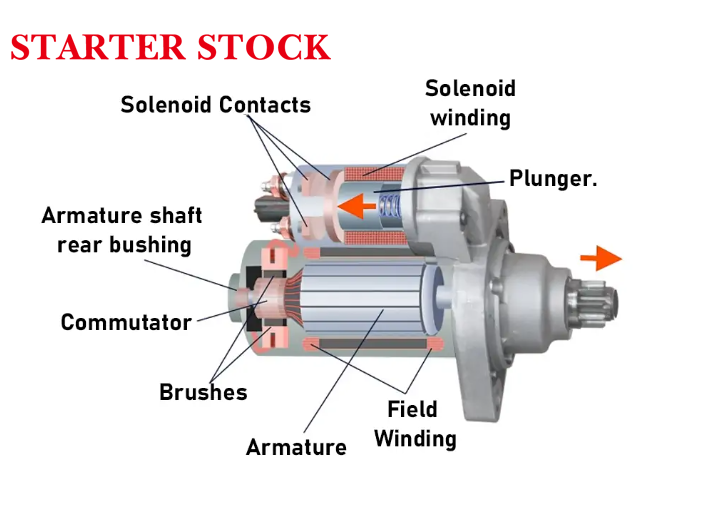
People hand me a starter and say, "This is broken." Sure, but what's broken inside? It's not just a magic spinning can. When I take one apart on my greasy bench, here's the cast of characters that make the show happen:
The Muscle (The DC Motor): This is the core. It's built for one thing: insane, instant torque. Inside, there's a spinning center piece called the armature wrapped in copper wire, sitting inside a ring of powerful magnets (or electromagnetic field coils in older ones). When you hit the juice, the magnetic fight between them is what creates the spin. It's simple physics, executed with brute force.
The Brain and Bouncer (The Solenoid): This is the cylindrical lump bolted on top. It's a heavy-duty switch with an attitude. When it gets the signal from your key, an electromagnet inside yanks a metal rod. This rod does two critical jobs at once—a real multitasker.
The Lunge (The Drive/Bendix): That rod from the solenoid is hooked to a fork that shoves a little pinion gear forward. This gear has to crash into the massive ring gear on your engine's flywheel. It's a metal handshake. This assembly also has a brilliant one-way clutch. Once the engine fires and spins faster than the starter, it kicks the pinion gear out. If it didn't, the engine would spin the starter motor like a turbocharger and literally explode it. I've seen the shrapnel; it's not pretty.
The Sacrificial Lambs (The Brushes): These are blocks of carbon that press against the spinning armature, feeding it power. They wear down with every start, like an eraser. When they're gone, the circuit breaks. They're designed to be the thing that dies, because they're cheap to replace compared to the whole armature.
The Alignment (Bushings/Bearings): Simple sleeves that hold the spinning armature shaft in place. When they wear out, the armature wobbles, grinds, and dies a noisy death.
It's a beautifully violent little package. Everything has to happen in a split second, in perfect sequence.
3. The Two-Second Miracle (And How It Usually Works)
Let's walk through what should happen when you turn the key. This is the checklist in my head for every "won't start" job:
The Signal: You turn the key. A small, maybe 5-amp, current runs from the battery, through the ignition switch, past a safety sentry (like the "you-must-be-in-park" switch), down a wire, and taps the solenoid's "S" terminal.
The Clunk: That small current wakes the electromagnet in the solenoid. It yanks its plunger inward with a sound you know—that solid CLUNK. That's a good sound.
The Lunge and Mesh: The plunger, via a lever, throws the pinion gear out. It crashes into the teeth of the flywheel's ring gear and meshes. This is a violent engagement. It has to be.
The Main Event: At the very end of its travel, that plunger does its second job: it slams a thick copper disc onto two massive contact points. This connects the battery's main cable directly to the starter motor. Now, 150 to 300 amps of raw, unfiltered battery power floods into the motor windings.
The Crank: The motor screams. Its torque is transferred through the meshed gears to spin the flywheel, which turns the crankshaft, which pumps the pistons. Air and fuel get sucked in, the spark plugs fire, and combustion takes over. The engine is alive.
The Retreat: You let go of the key. Power to the solenoid cuts. A big spring shoves the plunger back. This snaps the copper disc off the contacts (killing the motor) and yanks the pinion gear out of the flywheel. Silence. Job done.
Any weak link in this chain—a tired battery, a corroded wire, worn solenoid contacts—and the whole dance falls apart.
4. Not Just for Sedans: Starters in the Wild
While your car's starter is what you'll curse most often, these things are everywhere there's a gas or diesel engine that needs a beginning. My shop has seen them all:
Motorcycles & ATVs: Smaller, lighter, but just as finicky. Failure here means a bump start or a long, embarrassing walk.
Boats & Jet Skis: These are built mean, with extra seals and coatings to fight saltwater. A failure here isn't an inconvenience; it's a potential safety issue.
Lawnmowers & Generators: The rugged, simple ones. Their enemy is grass clippings, dirt, and being left out in the rain.
Tractors & Farm Gear: Big, often 24-volt beasts that have to work after sitting in a field for months.
Snowblowers & Snowmobiles: They need to fire up in freezing cold, every single time. No second chances.
The principle is identical, but the specs, the mounting, the durability—they're all over the map. This is why finding the right replacement is half the battle.
5. Learning Its Language: What a Dying Starter Sounds Like
Starters rarely die suddenly. They complain first. You just have to know how to listen:
The Slow Crank: "Rrrrrr... rrrrrr... rrrrrr." It sounds tired, lazy, labored. Like it's dragging the engine through mud. This is often weak brushes, terrible battery connections, or a motor on its last legs.
The Solo Click: One loud, lonely CLICK from under the hood, then silence. This is the solenoid's party trick: it can pull in (the click) but the main contacts inside are too burnt or pitted to pass current to the motor. Very common.
The Grind of Doom: A loud, horrible, metal-on-metal grinding. This is the sound of the pinion gear teeth skipping over the flywheel teeth. It means the solenoid isn't throwing it out fully, or the teeth on either gear are chewed up. Ignore this and you'll be buying a flywheel too.
The Whirring Spin: You hear the starter motor itself whirring away happily, but the engine doesn't budge. The one-way clutch in the drive assembly is toast. The gears aren't engaging.
The Intermittent Gremlin: Works fine when cold. Dies when hot. Works sometimes if you whack it with a hammer. Works on Tuesday but not Thursday. This is almost always worn brushes or a heat-sensitive fault in the solenoid.
6. Why They Quit: The Real Reasons
They're tough, but they're not immortal. Here's what kills them, in order of what I see most:
Old Age (Wear): Brushes wear down to nubs. Solenoid contacts get cratered from years of arcing. Bushings wear, causing drag and wobble.
The Heat: They're often mounted right next to the exhaust manifold. They get baked, day in, day out. Heat kills insulation and weakens everything.
The Elements: Road salt, mud, water. Corrosion gets into the electrical connections, creating resistance. Resistance creates heat, and heat kills starters.
Electrical Neglect: A weak or dying battery is a starter's worst enemy. It forces the starter to draw more amps to do its job, which overheats it and cooks it from the inside out. Bad ground cables do the same thing.
Owner "Help": Holding the key in "start" for 10 seconds straight. Cranking it over and over and over. This is just thermal abuse.
7. The Bench Doesn't Lie: My Favorite Test
When a car gets towed in with a "no-crank," the starter is suspect #1. But I don't just throw parts at it. The truth comes out on the bench test.
We pull the starter, clamp it securely in the vise (because it will try to jump out), and hook jumper cables directly from a known-good battery to it. No car wiring, no switches, no guesswork.
We give it the signal. A healthy starter responds with a fierce, instant spin and that solid CLUNK-SCREAM. We can also measure its amp draw with a clamp meter. Too high means it's binding up inside. Too low means it's not making good contact (brushes). This test is fast, definitive, and satisfying. It tells you the component's soul.
8. The Eternal Question: Fix It or Chuck It?
Once we know it's dead, the customer gets the talk.
Rebuild It: For a classic car part, a rare marine starter, or an expensive industrial unit, this makes sense. You buy a kit with new brushes, a solenoid contact kit, and bushings. It's skilled, detail-oriented work. It's for the sentimental or the cost-effective on high-dollar parts.
Replace It: For 99% of daily drivers from the last 30 years, this is the answer. You swap the old one for a remanufactured unit. But here's the kicker: not all reman starters are created equal. The $79 special from the bargain bin and the $189 unit from the specialty shop are worlds apart in the quality of the parts they used inside. The cheap one uses the worst brushes, the thinnest solenoids. It's a coin toss.
9. The Parts Problem Nobody Talks About
This is the dirty secret of the trade, and the nightmare for any serious hobbyist. You need a starter. Not for a 2020 Camry—anyone has those. You need one for a 1985 BMW motorcycle, a specific Mercruiser stern drive, or a vintage industrial air compressor.
Your options stink:
The Dealer: "It's discontinued." Or, "Sure, that'll be $700 and it'll come from Germany in 6-8 weeks."
The Local Parts Store: They look it up, shrug, and offer a "universal" one that requires wiring modifications and probably won't last.
The Online Jungle: Scrolling through 15 nearly identical listings from sellers with names like "QualityPartsDirect88." Photos are stock images. "OEM Quality!" screams the description. Is it new? Refurbished? A knockoff? Who knows. You're gambling with your time and money.
For my business, this uncertainty is a profit-killer. For a guy in his garage, it's project-killer.
10. How I Finally Solved My Sourcing Headaches
I got sick of the gamble. I needed a source that acted like the old-school, grumpy-but-knowledgeable parts guy who only stocked good stuff.
After a lot of dead ends, I found StarterStock. It felt different. It wasn't a faceless mega-store. Here’s why it’s now my first stop for anything beyond the most common part:
They Get the Small Stuff: Need one starter for a prototype robot or a '70s dirt bike resto? They don't hang up on you. They work with actual factories that will do small runs and samples. This is how real projects happen.
The Veil is Lifted: Every supplier is vetted. I can see their facility, their certifications, examples of their work. It cuts through the "mystery meat" aspect of parts buying. I'm buying from a workshop, not a shadow.
You Keep Control: The whole quote-to-delivery process is clear. And for critical parts, you can pay a small fee for an independent inspection report before it ships. After installing a "new" starter with hairline cracks in the housing, I will gladly pay for this peace of mind.
The Real Value: The Tribe: This is what sealed it for me. Their blog and forums aren't marketing fluff. It's mechanics, engineers, and boat builders swapping real fixes, warning about bad batches, and sharing tricks. It's the collective knowledge of the trade, online. I've learned more there than from some manuals.
It turned the worst part of my job—chasing down a reliable part—from a stressful hunt into a few clicks. I get my time back.
11. Parting Thoughts: Give the Thing Some Respect
The starting motor is a workhorse. It asks for almost nothing—just a clean connection and a brief command. In return, it gives your engine life, thousands of times, often for a decade or more.
Understanding it isn't just technical knowledge. It's freedom. It's the difference between knowing you have a bad starter and knowing you don't, which is often more valuable. It's the difference between an informed repair and getting taken for a ride.
So next time you turn the key and hear that glorious, ugly grind, remember the little team of components making it happen. And if the day comes when all you get is a click, you'll know the steps: listen, test, and find a replacement worthy of the job.