
-
90
-
2026-01-15 10:30:04
Table of Contents
1. The "Silent Click" Syndrome: An Introduction
2. Visual Identification: Don’t Mistake the Alternator for the Starter
3. The Universal "Map": Following the High-Amperage Trail
4. Deep Dives into Engine Geography
a. Standard Automotive Layouts (RWD vs. FWD)
b. The "V-Engine" Trap: Living in the Intake Valley
c. Powersports & Niche Gear (ATVs, Snowmobiles, Jet Skis)
d. Marine Engines: The Saltwater Battle
e. Lawn & Garden: Small Motors, Big Headaches
5. Why Do Engineers Hide Them? (A Mechanic’s Grudge)
6. The "Hammer Trick" and Other Field Diagnostics
7. Sourcing the Replacement: The B2B Nightmare
8. StarterStock: How We’re Fixing a Broken Supply Chain
a. The Small-Batch Revolution
b. Beyond the "Open Market": Our Vetting Process
c. Total Transparency: From Factory Floor to Your Door
9. The Community Factor: Knowledge as a Part of the Product
10. Final Thoughts: Don’t Let a Motor Stall Your Innovation
=====================================================================================================================

1. The "Silent Click" Syndrome: An Introduction
I’ve spent the better part of two decades covered in grease, and if there’s one thing that unites every machine owner—from the guy with a 1960s Mustang to the engineer designing a new fleet of autonomous lawnmowers—it’s the moment of the "Silent Click."
You turn the key, you expect life, but all you get is that lonely, metallic snap of a solenoid that just isn't engaging. In that moment, your day stops. But here’s the thing: finding the starter motor shouldn't feel like an archaeological dig. Whether you’re a DIYer trying to get to work or a procurement lead looking to source 200 units for a new production line, you need to know exactly where that "heart" is located.
At StarterStock, we live and breathe this stuff. We don't just sell parts; we understand the frustration of a stalled project. So, let’s get our hands dirty and find that motor.
2. Visual Identification: Don’t Mistake the Alternator for the Starter
Before you start unbolting things, let’s be clear on what we’re looking for. I’ve seen plenty of beginners try to "jump-start" an alternator because they saw wires.
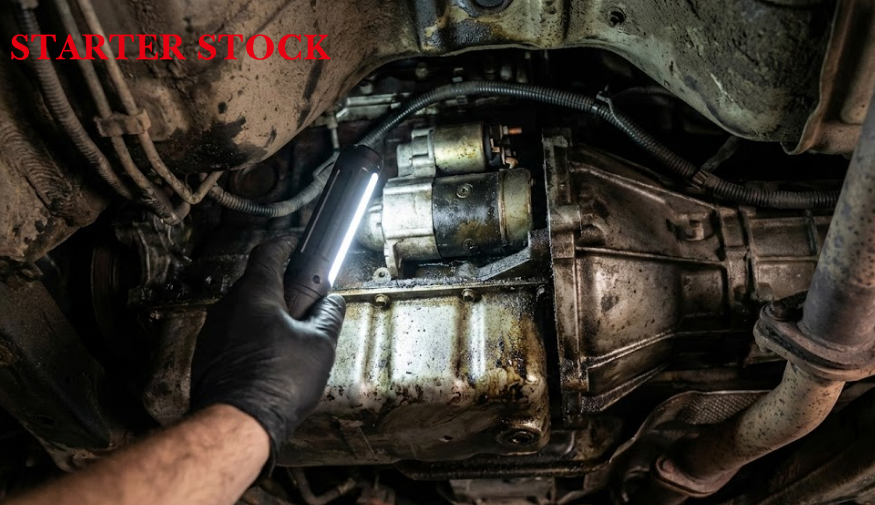
A starter motor is usually a heavy, dual-cylinder beast.
● The Big Cylinder: That’s the motor itself. It’s packed with heavy copper windings designed to handle massive electrical surges.
● The Small Cylinder: That’s the solenoid, usually bolted right onto the motor’s back. It’s the "brain" that tells the gear to fly out and grab the engine.
In most applications—be it a motorcycle, a yacht, or a tractor—the starter is going to be one of the heaviest electrical components on the frame. If it looks flimsy, it’s probably not the starter.
3. The Universal "Map": Following the High-Amperage Trail
Engineers are a diverse bunch, but they all have to follow the laws of physics. To start an internal combustion engine, you have to spin the flywheel (or flexplate). This is a massive geared wheel that sits right where the engine meets the transmission.
The Golden Rule: If you find the junction where the engine block bolts to the transmission, the starter is somewhere on that circular perimeter.
The "Follow the Red" Method: If you’re dealing with a cluttered engine bay, find your battery. Look for the thickest, meanest-looking red cable. One lead goes to your fuse box, but the "main artery" goes directly to the starter. Trace that cable. It won't lead you to the alternator or the AC compressor; it will lead you straight to the starter solenoid.
4. Deep Dives into Engine Geography
Standard Automotive Layouts (RWD vs. FWD)
In a Rear-Wheel Drive (RWD) setup, life is usually easy. The engine sits "North-South." Crawl under the car, look at the side of the engine block near the bottom of the transmission bellhousing. There it is—usually held in by two or three beefy bolts.
Front-Wheel Drive (FWD) is where things get cramped. Because the engine is "East-West," the starter is often sandwiched between the engine block and the radiator, or worse, tucked under the exhaust manifold where it’s cooked every time you drive.
The "V-Engine" Trap: Living in the Intake Valley
If you own a modern V8 or V6 (especially from the Lexus, Toyota, or Cadillac families), you might look under the car and see... nothing. No starter. That’s because the engineers tucked it into the "valley" of the V, right underneath the intake manifold. To change it, you’re not just crawling under the car; you’re performing "open-heart surgery" on the top of the engine.
Powersports & Niche Gear (ATVs, Snowmobiles, Jet Skis)
This is where StarterStock really shines. In the powersports world, space is a luxury.
● Motorcycles: Usually tucked behind the cylinder bank.
● ATVs/UTVs: Often located low, near the rear of the engine, usually protected by a skid plate that’s likely covered in mud.
● Jet Skis: These are notoriously difficult. The starter is often tucked way down in the hull, where it’s susceptible to corrosion—a primary reason why we source specifically "sealed" units for our marine clients.
Marine Engines: The Saltwater Battle
If you’re on a boat, the starter is usually on the side of the engine, but it’s often "ignition protected." You can't just slap a car starter on a boat—if a spark leaks out in a gas-fume-filled bilge, things go "boom." We ensure our marine-grade stock meets those life-saving SAE J1171 standards.
5. Why Do Engineers Hide Them? (A Mechanic’s Grudge)
I’ve heard every conspiracy theory: "They put it there so the dealership can charge more for labor!"
While it feels that way, it’s usually about packaging. Modern vehicles are packed with turbos, catalytic converters, and steering racks. The starter gets the "leftover" space. Also, the closer the starter is to the battery and the center of the engine, the less voltage drop you get. It’s efficient for the machine, even if it’s a nightmare for the person holding the wrench.
6. The "Hammer Trick" and Other Field Diagnostics
Before you go buying a new unit on StarterStock, make sure you actually need one.
1. The Tap Test: If your starter is clicking but not turning, have someone hold the key in the "start" position while you give the starter motor body a firm (but not destructive) tap with a hammer. If it fires up, your internal brushes are shot. It’s a temporary fix that tells you a replacement is mandatory.
2. The "Voltage Drop" Check: Use a multimeter. If the starter is getting 12.6V but doing nothing, it’s an internal failure. If it’s getting 8V, you’ve got a bad ground or a corroded cable.
7. The Sourcing Nightmare: Why Traditional B2B is Broken
Let’s talk shop. If you’re an innovator—maybe you’re building a prototype for a new type of electric-assist agricultural drone or a custom fleet of snow-clearing robots—where do you get your motors?
You have two bad options:
● Option A: Contact a massive OEM manufacturer. They’ll laugh if you want fewer than 5,000 units. Their lead times are "whenever we feel like it."
● Option B: Scour the open marketplaces. You’ll find something that looks right, but the quality is a gamble, the documentation is non-existent, and you have zero recourse if the part fails in the field.
This "gap" in the middle—the space for the innovators and the small-to-medium manufacturers—is where we live.
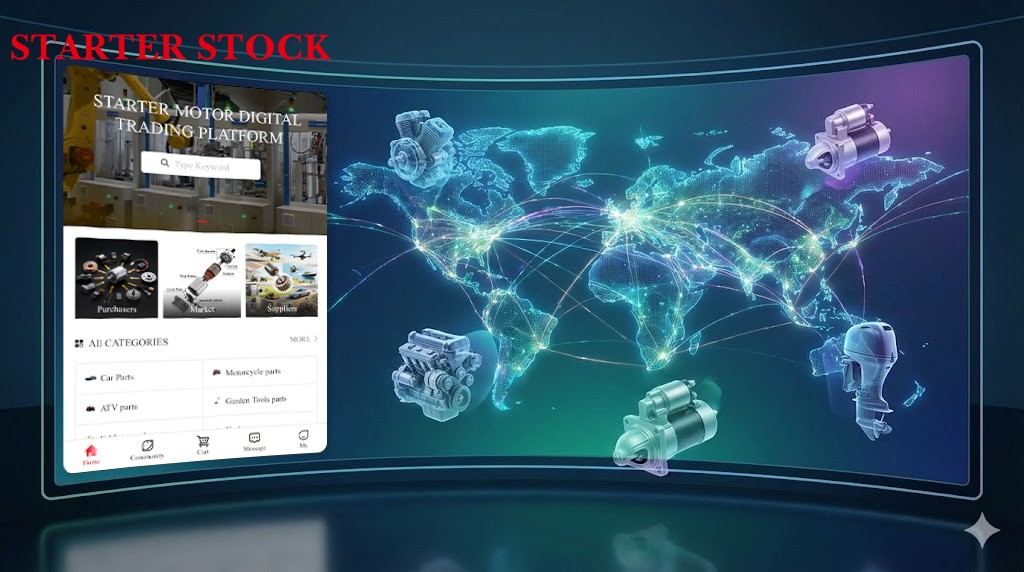
8. StarterStock: How We’re Fixing a Broken Supply Chain
We built StarterStock because we were tired of seeing good projects die because of bad sourcing. We aren't just a "listing site." We are a specialized ecosystem designed to empower you.
1. The Small-Batch Revolution
Need 10 units for a test run? 50 for a pilot launch? We’ve spent years building relationships with top-tier suppliers who are actually willing to work with small-batch orders. We believe the next big industry breakthrough starts with a single prototype, and we’re here to supply the "spark" for it.
2. Beyond the "Open Market": Our Vetting Process
We don't let just anyone sell on StarterStock. Every factory in our network undergoes a serious audit. We look at their ISO certifications, their past projects, and their actual manufacturing capacity. When you buy through us, you’re accessing a curated "inner circle" of global suppliers.
3. Total Transparency: From Factory Floor to Your Door
The biggest fear in global sourcing is the "Black Box"—you send money and hope a crate shows up. With StarterStock, you get:
● Direct Communication: Talk to the experts at the source.
● Third-Party Inspection: Want a quality report before the shipment leaves the factory? We can handle that.
● Trade Support: We handle the logistical "dark arts" of international shipping and payments, so you can stay focused on your engineering.
9. The Community Factor: Knowledge as a Part of the Product
The industry is changing. We’re seeing a shift toward brushless technology, higher voltage systems (48V is the new 12V in many sectors), and smarter regulators.
At StarterStock, we’ve built a community blog and forum where actual technicians and engineers swap tips. Need to know the torque specs for a specific motorcycle starter? Or how to bypass a faulty regulator on a vintage outboard? Our community is a living library. We believe that Knowledge + Parts = Success.
10. Final Thoughts: Don’t Let a Motor Stall Your Innovation
Whether you’re underneath a truck with a flashlight or at a desk designing the next great mechanical marvel, the starter motor is your gateway to motion.
Finding it is just the beginning. Sourcing it correctly is what ensures your project actually makes it to the finish line. Don't settle for the "standard" B2B compromise. Don't risk your reputation on unverified parts.
Join the StarterStock community. From automotive and motorcycles to marine and industrial machinery, we have the network, the transparency, and the expertise to keep you moving.