
-
65
-
2026-01-27 10:35:50
Okay, let's talk about a repair shop classic. The driver's side wiper works fine, but the passenger side just… sits there. You flick the stalk, hear the motor whirring away, and watch one blade do all the work while its partner takes a permanent vacation. Your first thought? "Great. The wiper motor's shot." I get it. It's the obvious suspect.
But here's the truth from the shop floor: in probably 8 out of 10 cars that get towed or driven in with "one dead wiper," the motor is perfectly healthy. You're not paying for a new motor. You're paying for me to find the real problem, which is almost always cheaper and simpler. Let me walk you through exactly how we figure it out, so you can check the easy stuff yourself before you spend a dime.
The Two-Second Test That Tells You Almost Everything
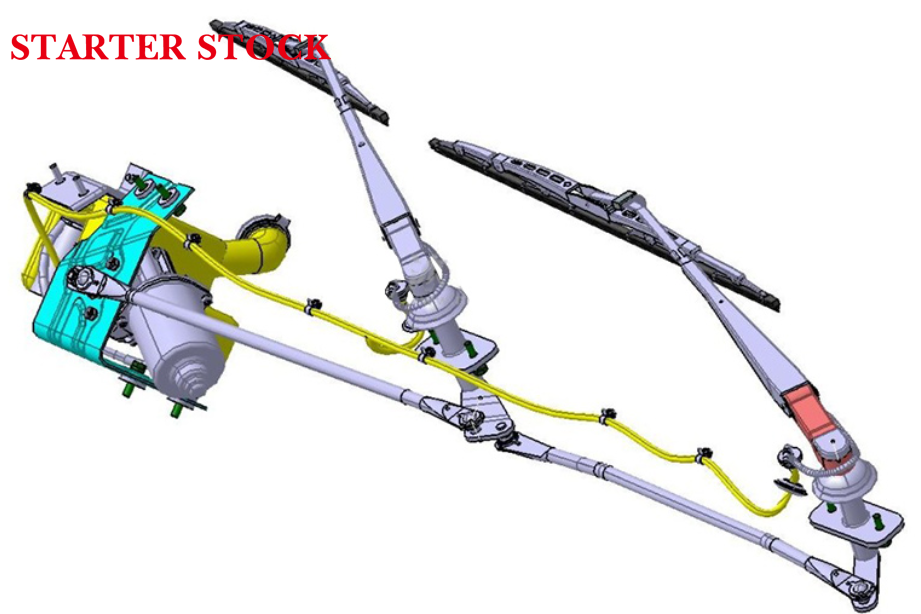
Before you touch a tool, do this:
Turn on the wipers. Listen closely near the base of the windshield. Hear that steady "zzzzzzt" or humming sound? That's your wiper motor working. If you hear it, stop worrying about the motor right now. It's running. The problem is mechanical—the motor's effort isn't reaching the blade.
Now, turn the ignition OFF. Go outside and try to move the dead wiper arm by hand, like you're helping it sweep. Does it feel…
Loose and floppy, like it's not connected to anything? Bingo. This is the most common fix. The linkage has come disconnected. It's a five-minute repair.
Frozen solid, as if it's welded in place? The pivot shaft under that arm is rusted shut. Common on older cars, or in places that use road salt. The motor can't break it free.
Stiff and gritty, or it moves but then binds up? Something's bent, broken, or out of alignment inside the linkage.
That simple listen-and-feel test points you in the right direction 90% of the time.
The Real Usual Suspects (From Most to Least Likely)
Forget the motor for a second. Here's what we actually find when we pop the hood:
#1: The Disconnected Link (The "Classic")
Under the plastic cowl at the base of your windshield, the wiper motor moves a little "crank arm." Attached to that are one or two metal rods (linkages) that go to each wiper pivot. The ends of these rods use cheap plastic ball-and-socket joints. Heat, cold, and constant motion make that plastic brittle. Eventually, the ball pops out of the socket. The motor spins, the rod flops around, and one wiper does nothing.
The Fix: Often, you can just snap the ball joint back in. Sometimes you need a new clip, or in a real pinch, a heavy-duty zip-tie to hold it together. A new linkage rod is a $20-$50 part.
#2: The Rusty Pivot (The "Northern Car Special")
The wiper arm bolts onto a vertical pivot shaft that sticks up through the body. This shaft needs to turn freely. If its seal fails (and it often does), water and road salt get in. Years later, it's a solid block of rust. The motor strains, maybe burns out a fuse, but that shaft isn't budging.
The Fix: This is harder. Soaking it in penetrating oil might work if you're lucky. Usually, it requires removing the whole wiper transmission to replace the seized pivot shaft. It's more labor than parts.
#3: The Loose Wiper Arm (The "Easy Win")
I can't tell you how many times a "dead" wiper was fixed with a single turn of a wrench. The large nut that holds the wiper arm onto the pivot shaft can work itself loose. The motor turns the shaft, but the arm just sits there spinning freely on top.
The Fix: A 13mm or 15mm wrench. Tighten the nut. Seriously, check this first.
When It Actually Is the Motor (The Rare Case)
You've checked all the above. The linkage is connected and moves freely by hand, the pivots aren't rusted, and the arms are tight. Now we consider the motor.
There's one surefire test: Remove both wiper arms. Then, have a friend turn on the wipers. Look at the little studs the arms were bolted to. Are they both rocking back and forth?
If both studs are moving: Your motor is fine. The problem is in the arm or something you missed. Re-check.
If only one stud is moving: Then, and only then, you have an internal failure inside the wiper motor assembly. A gear has likely stripped on one side. Now you need a new motor.
The Big Mistake Everyone Makes
The worst thing you can do is throw a new motor at a problem caused by a rusted pivot or seized linkage. Here's why: that new motor will be trying to move a frozen, broken mechanism. It will either burn itself out immediately, or you'll burn out its fuse. You'll have spent $150+ on a part and still have the original problem. Always free up the mechanism by hand before installing a new motor.
Bottom Line: Your wiper motor is tougher than you think. That single dead blade is almost always a $50 mechanical problem, not a $200 electrical one. Start with the free checks—listen, feel, and tighten. You might just solve it with the tools you already have in your garage drawer. Save the motor money for when something actually breaks.