
-
88
-
2026-01-29 17:26:57
A detailed specification and maintenance guide for electric motorcycle motors is provided.
This article provides a comprehensive analysis of electric motorcycle motors, detailing their manufacturing processes, operating principles, performance characteristics, and daily maintenance methods.
Electric motorcycles are emerging as a new favorite in modern transportation, and as the heart of these vehicles, the motor's importance is self-evident.This article will detail the composition of electric motorcycle motors. It will also detail their operating principles. The types of motors will be covered. Their characteristics will be explained. The article will go through daily maintenance techniques.
Electric motorcycle motors typically consist of the following main components:
Stator and rotor.
Stator: The stationary part of the motor, with primary responsibility for the generation of the magnetic field. In electric motorcycles, the stator's location is of design-dependent nature, with options of internal or external mounting. Well, in an internal stator motor, like a hub motor, the motor shaft also does the job of the stator. But with an external stator, that's when you usually get the motor housing around it.
Rotor: The moving part of the motor, whose rotation generates mechanical energy. The categorisation of motors used in electric motorcycles is into brushed and brushless types (exploration of the comparison between brushless and brushed motors), with each type's rotor operating through distinct mechanisms.
Brushes and brush holder.
Brushes: In brushed motors, the transmission of current to the motor windings is achieved by the brushes. Typically made of carbon for excellent conductivity, brushes undergo wear and tear during operation and require periodic replacement.
Brush holder: Also known as the brush carrier, its function is the securing of the brushes in position to ensure effective contact with the commutator.
Commutator:
In brushed motors, the function of the commutator is the reversal of the direction of current flow, enabling the motor to operate properly. It's made up of insulated metal bits that detect and regulate the contact between the brushes and the current.
Magnet:
Magnets are a really important part of motors.Well, they usually use magnets made of neodymium, iron and boron to create a strong magnetic field. The efficiency and power of electric motorcycles is increased by this magnetic material, which is a really important factor for electric motorcycles.
Types of Electric Motorcycle Motors
Most electric motorcycle motors are DC motors, primarily categorized by design and function as follows:
Brush Motor
The function of brush motors is the utilisation of brushes and commutators for the control of current flow; the passing of current through brushes on the rotor shaft is the cause of rotation. The operation of this motor is on a relatively simple principle, making it suitable for small electric vehicles and motorcycles.
Advantages:
It's got all the latest tech, and it's not expensive to make.
Maintaining it is a breeze, and any parts you need are readily available. a
Disadvantages:
The lifespan of the brush is restricted, generally necessitating substitution after 2,000 hours of use.
Lower efficiency and prone to overheating. Often produce significant noise.
Brushless Motor:
As the designation indicates, brushless motors do not utilise brushes. Instead, there is reliance on complex electronic controllers for the regulation of current direction, resulting in quieter and more efficient operation. The suitability of brushless motors for high-performance electric motorcycles is well-documented.
Advantages: - High efficiency
- Long service life
- Simple maintenance
Minimal operational sound, making them appropriate for city and tranquil settings.
Disadvantages: Intricate configuration, exacting controller specifications.
Well, they cost more than brushed motors, don't they?
Permanent Magnet Motors:
The utilisation of permanent magnets in permanent magnet motors delivers high symmetry and efficiency during operation, providing stable output.The use of these components is commonplace in electric motorcycles with power ranges from 180W to 500W, and is particularly prevalent in small, lightweight models.
Please be aware: Motors with permanent magnets are heat-sensitive. The occurrence of demagnetisation may be caused by high temperatures. The necessity of attention to heat dissipation and temperature control during operation is essential.
Series-Wound Motors
Series-wound motors are characterized by both rotor and stator windings composed of coils. They are commonly used in electric cargo tricycles. These motors lack permanent magnets, eliminating the risk of demagnetization.
Working Principle of Electric Motorcycle Motors
The working principle of electric motorcycle motors generally consists of two parts: brushed motors are for the redirection of current through brushes and commutators, while brushless motors rely on electronic controllers for the management of current flow. In either type of motor, the generation of a magnetic field by current passing through the stator windings drives the rotation of the rotor, thereby producing mechanical power.
Working principle of brushed motors:
In brushed motors, the brushes and a commutator are connected. This allows smooth current flow to the rotor. When electricity flows through the stator windings, it creates a magnetic field that makes the rotor spin. But if the brush gets worn out, it can mess up the contact, so you've got to keep an eye on it and replace it regularly.
Brushless Motor Operation: Brushless motors don't have brushes or commutators. Instead, they use electronic controllers to automatically control the current. The core component is the Hall sensor, the function of which is the measurement of rotor position to ensure current changes sequentially in three-phase control, thereby producing stable rotation.
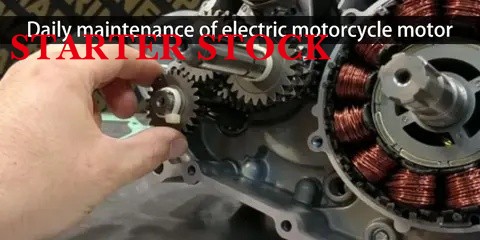
Maintenance tips for electric motorcycle motors
The engine is the power source for electric motorbikes, so correct upkeep and attention are vital. Here are some specific maintenance recommendations:
Regularly inspect the motor's condition: First things first, have a look outside to make sure there's no damage or leaks. So, if your motor's making some weird noises, like clicking or vibrating, while it's on, you gotta turn it off and get it checked out, you know?
Please note the following advice on cleaning and waterproofing. Electric motorcycle motors are not fully waterproof, so do not put them in water when it is raining.Accumulated water can cause internal short circuits, which affect motor operation. After use, clean the outside of the motor often to stop dirt and grime building up over time. This can stop the motor from getting hot.
Proper ventilation and heat dissipation: Brushless motors often get worn out because they get too hot. It is very important to make sure there is air moving around the motor and that heat is removed to make them last longer. So, when you are designing parking spaces for electric motorcycles, make sure you avoid places that are hot or closed.
Regular maintenance and component replacement: For brushed motors, regularly inspect and replace the brushes. The replacement of brushes is generally around 2000 hours, though this should be subject to adjustment based on usage patterns. For brushless motors, while brushes have extended lifespans, maintenance of controllers and sensors remains essential for ensuring accurate feedback.
Moderate loading: The careful management of weight by electric motorcycles is essential for the prevention of overloading during the transportation of loads. The subjecting of the motor to pressures exceeding its design limits is a consequence of excessive weight. This can result in overheating or damage.
Don't make any changes to the car without asking. The engine, battery and controls of an electric motorcycle work perfectly together. If you change it without asking, it might not work so well or it might even be dangerous.