
-
72
-
2026-02-12 15:14:44
I had a guy named Rick come in last July. 2008 Mazda 3, 167,000 miles, original starter.
"Morning starts, perfect," he said. "Drive an hour, shut it off ten minutes, come back—click, grind, or just whine. Wait twenty minutes, fires right up."
I walked him to the bay, popped the hood, and pointed.
Right there. Bolted to the bellhousing, three inches from the exhaust pipe. On a July afternoon, that pipe is hot enough to cook on. The starter soaks up every degree.
You can't see what happens inside when it gets that hot. But you can hear it. And if you've heard it enough times, you know exactly what it's telling you.
What Heat Actually Does Inside That Housing
The parts inside a starter are machined to fit together at room temperature. The shaft is steel. The housing is aluminum. The bushings are bronze. None of these materials expand at the same rate when you heat them up.
Steel grows. Aluminum grows faster. The shaft gets fatter. The housing closes in around it. Clearances measured in ten-thousandths of an inch when the car was new can disappear entirely at 220 degrees.
I had a 2005 Civic in here maybe eight years ago. Cold start, perfect. Hot start, one click and nothing. Battery voltage was fine. The solenoid was pulling in. But the armature was binding inside bushings that had swollen from years of heat cycles. The motor couldn't overcome its own friction. It wasn't the battery. It wasn't the cables. The starter was strangling itself.
The Grease on the Splines Stops Being Grease
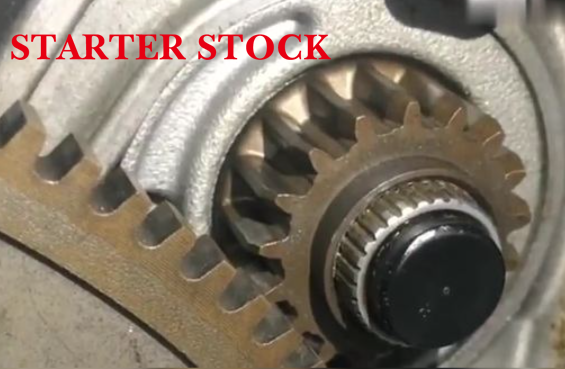
That black, crusty residue on old drive gear splines? It started as clean, amber-colored grease. Then it baked.
Fifteen years of heat cycles, each one cooking out a little more of the oil. Mix in carbon dust from the clutch. Mix in microscopic metal particles from a hundred thousand engagements. Mix in road grit that finds its way past tired seals. What you end up with isn't lubricant. It's hard, brittle crust.
A cold starter, with full solenoid throw and a return spring that still has some fight left, can sometimes punch through that crust. The gear extends, the engine cranks, and you never know how close you came to being stranded.
A hot starter? The solenoid doesn't hit as hard. The spring is weaker. The gear peeks out halfway, meets that crust, and stops. You get grinding, or you get nothing.
The One-Way Clutch Loses Its Bite
Inside that clutch housing are hardened rollers wedged into tapered ramps. When the starter spins, they jam into the narrow end. Outer housing locks to inner shaft. Torque flows.
After a hundred thousand engagements, the rollers aren't sharp anymore. They're polished smooth. The ramps wear down into shallow depressions. Everything still works, but the margin gets thinner every year.
Cold, with everything contracted, those worn rollers might still catch. Hot, when the race expands and the geometry shifts? They just skate.
You hear it as a high, hollow whine. The motor is spinning. The gear is out. But nothing locks. No torque reaches the flywheel. It sounds almost healthy, like the starter is trying harder. It's not. It's just wasting energy.
The Noise Tells You Which Part Quit
I don't guess. The car tells me what's broken. I just listen.
High whine, no crank. That's the one-way clutch. The motor is freewheeling, driving nothing but itself.
Slow, labored groan. That's the bushings. The shaft is binding inside bearings that have swollen from heat. The motor is fighting its own housing. Sounds like a battery with one dead cell, but the battery tests fine.
Rapid clicking. That's the solenoid contacts. The copper disc and terminals are pitted and burned. Cold, they might still make contact. Hot, with everything expanded, the contact area shrinks. Voltage drops. The solenoid chatters.
Grinding. That's engagement. The gear is coming out, but not far enough. It's skimming the face of the ring gear instead of slamming home. Sometimes it's gummed splines. Sometimes it's a tired solenoid with short throw. Sometimes it's the flywheel itself.
The Hard Part: Making It Fail On Command
Here's the problem with heat-soak failures. The car is never broken when it's sitting in your bay. You have to make it angry.
I learned this from an old transmission guy named Pete, back when I was still the apprentice crawling under cars. He said, "You wanna find a gremlin? Don't wait for it to show up. Piss it off."
So I take the car out. Highway, fifteen, twenty minutes. Get everything up to full operating temp. Pull it back in, shut it off, pop the hood.
Then I wait.
Three minutes. Five. Seven. Twelve. Every car has its own timing. That Mazda failed at six minutes—long enough for the radiator fan to stop, not long enough for the starter to cool below 180.
Then I crank it. And I listen.
If it whines free, I pull the starter. Bench test. Direct power to the motor terminal. If the shaft spins and the drive gear doesn't, or spins weak, that's the proof.
If it cranks slow, I check voltage drop at the starter B-terminal while it's still hot. Cold, it might show 10.2 volts. Hot, with the solenoid contacts expanded and the bushings binding, it might show 8.5. That's not a battery problem. That's a starter problem.
If it grinds, I don't order anything yet. I grab my drop light and my inspection mirror. Because I learned this lesson the hard way, and I only needed to learn it once.
The Flywheel: The Part Nobody Thinks to Check
A flywheel ring gear with 150,000 miles on it doesn't look like a new one. You can't see it with the starter installed, but once you pull the starter, the evidence is right there in the hole.
The teeth get polished. The leading edges develop a chamfer, a subtle ramp. A healthy starter with full voltage and a stiff return spring can still punch past that chamfer and bite in. It happens so fast you don't even notice the extra effort.
But a tired starter? Hot, with voltage sagging and throw shortened and the return spring fighting varnish on the splines? That pinion doesn't travel as far. Instead of slamming home, it skims the polished face and skips.
I know this because I was that guy. Put a starter in a 2002 F-150, customer paid cash, truck was back on a flatbed inside a month. He didn't say a word. Just handed me the keys and stood there with his arms crossed.
I ate that job. New flywheel, new starter, my time, his patience. You don't make that mistake twice.
So now I inspect. Every time. I bar the engine over by hand, put a light in the hole, and look at every tooth I can see. If there's shine, if there's a burr, if there's any kind of hook or mushrooming on the leading edge, I stop and have a conversation. The customer doesn't always like it. But they don't come back on a hook.
Why We Don't Rebuild Starters Anymore
Customers ask me this all the time. "Can't you just fix the part that's bad? Why do I need a whole starter?"
Here's the real answer.
That starter has been through fifteen years of heat cycles. The bushings are worn. The commutator has grooves worn into it from the brushes. The solenoid contacts are cratered. The return spring is fatigued. Even if I could magically install a brand-new one-way clutch into your old starter—and I can't, because I don't own the $2,000 press and the fixturing required to disassemble a modern drive end without destroying it—you'd still have a worn-out motor attached to that new clutch.
It would fail again. Probably within a year. And you'd be back in my bay with the same complaint and a receipt showing I already charged you for this repair.
A quality remanufactured starter isn't a patch. It's a reset. The housing is the only original piece. Everything that wears—the drive assembly, the one-way clutch, the solenoid contacts, the bushings, the brushes—is replaced with new components manufactured to original specs. The armature is tested, often machined true. The unit is run on a test stand under load, verified to produce rated torque at rated amperage. It comes with a warranty that actually means something.
Is it more expensive than a junkyard pull? Yes. Does it cost more than a rebuild kit and three hours of my time? Usually less, when you do the math honestly. Does it fix the problem the first time, every time? Yes. That's why we do it.
What I Told Rick
I had Rick standing in my bay watching me bar his engine over by hand. Drop light in the starter hole, inspection mirror on a swivel. I showed him the polish on the ring gear teeth, the slight rounding on the leading edges. I had him run his thumbnail across one.
"Feel that? It's not sharp anymore. It's a ramp. A new starter can still punch past it. A tired one just skims and skips."
I put the amp clamp on his battery cable and had him crank it hot. Eighty amps, steady. No load. Just the motor spinning itself to death. I showed him the screen.
"You could probably get another six months if you only drive it mornings," I told him. "But summer's here. Every time it grinds, it's taking more off that flywheel."
He asked what I'd do.
"Reman starter. Not junkyard, not rebuild kit. Quality unit. Check the flywheel. If it's polished but not hooked, run it. And stop worrying about getting stranded in August."
He went for it. Denso reman, new ground strap. Fourteen months later I saw him at the parts store. Said the car starts every time, hot cold rain shine. He'd almost forgotten what the grinding sounded like.
What I Learned From Old Chen
Early in my career, a 1999 Camry came in. Cold start perfect. Hot start, nothing. I had the multimeter out, wiring diagrams spread across the fender, convinced I'd find a corroded connector everyone else missed.
Chen watched me for twenty minutes, drinking tea from that stained enamel mug. Finally he set it down.
"Ever see a marathoner at the finish line? Standing, breathing hard, but fine. Ask him to run another mile right then, his legs cramp and he hits pavement. He ain't sick. He's just used up. That's your starter."
He ordered a reman unit and went back to his coffee.
I put it in, checked the flywheel, never saw that Camry again.
So Here's the Truth
A starter that only fails when it's hot isn't confused or cursed. It's just done.
Heat doesn't create new problems. It reveals the wear that's already there—polished rollers, baked grease, tired springs, worn bushings, chamfered flywheel teeth—and puts it where you can't ignore it.
Stop diagnosing. Start replacing. Get a quality reman unit. Inspect the ring gear while you're in there. Check the ground strap while you're under the car. Button it up and move on.
Your customer will thank you when their car starts at the gas station in August.