
-
74
-
2026-04-07 15:50:29
In the heavy-duty and small-engine industries, the electrical charging circuit is a frequent point of catastrophic failure. The system relies on a crude but effective partnership between the Magneto and the Rectifier-Regulator. This isn't just a simple connection; it’s a high-stakes conversion process where raw electromagnetic induction is hammered into a stable DC floor.
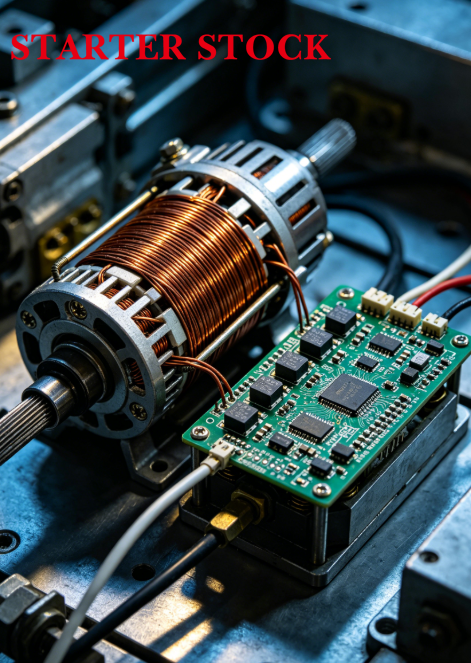
For procurement managers and field engineers, understanding the "why" behind component failure is the only way to spec parts that actually last in the field.
1. The Magneto: Raw, RPM-Dependent Induction
The magneto—specifically the Permanent Magnet Alternator (PMA)—is a "dumb" power source. Unlike a car’s alternator, which uses a voltage regulator to modulate the rotor's magnetic field, a magneto is always at 100% flux density.
As the flywheel spins its permanent magnets around the stator’s copper windings, it generates Alternating Current (AC). Because the magnetic field is fixed, the output is entirely dependent on crankshaft speed:
The Idle Problem: At 1,200 RPM, you might see a weak 16V AC.
The Redline Surge: At 8,000 RPM, that same stator can pump out 90V to 100V AC.
This creates a "wild" AC wave that increases in both voltage and frequency as the engine revs. If you’ve ever seen an LED headlight flicker or a digital dash glitch, you’re looking at the raw, untamed frequency of a magneto.
2. The Rectifier: Managing the Directional Flip
Since a 12V battery is a chemically-driven DC tank, feeding it AC is like trying to fill a bucket by shaking it back and forth; nothing stays inside, and the friction eventually destroys the bucket.
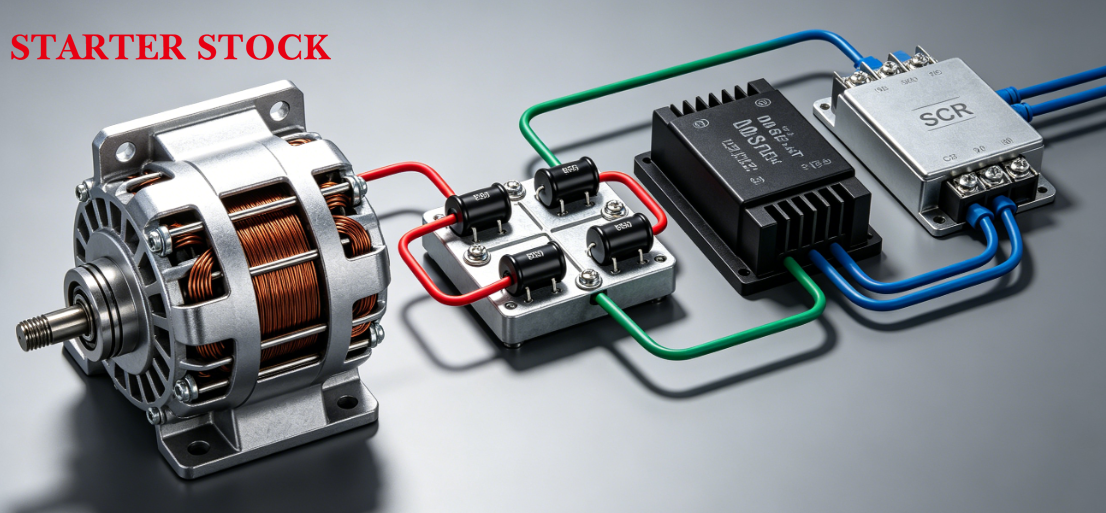
The Rectifier uses a bridge of silicon diodes to act as one-way check valves. These diodes "flip" the negative side of the AC sine wave, forcing electrons to move in one direction.
The Technical Catch: Every diode has a "forward voltage drop" (usually 0.7V to 1.1V). In high-amp systems, this small resistance generates significant heat. If the diodes are low-grade, they can leak AC back into the DC circuit—a phenomenon known as AC Ripple. This is the silent killer of lithium-ion batteries and modern EFI sensors.
3. The Regulator: Shunting the Surplus
Since the magneto is constantly over-producing power, the system needs a way to dump the extra energy. Most standard-duty units use SCR (Silicon Controlled Rectifier) regulation.
Once the battery reaches a set threshold (usually 14.4V), the SCRs "short" the excess stator current directly to the ground.
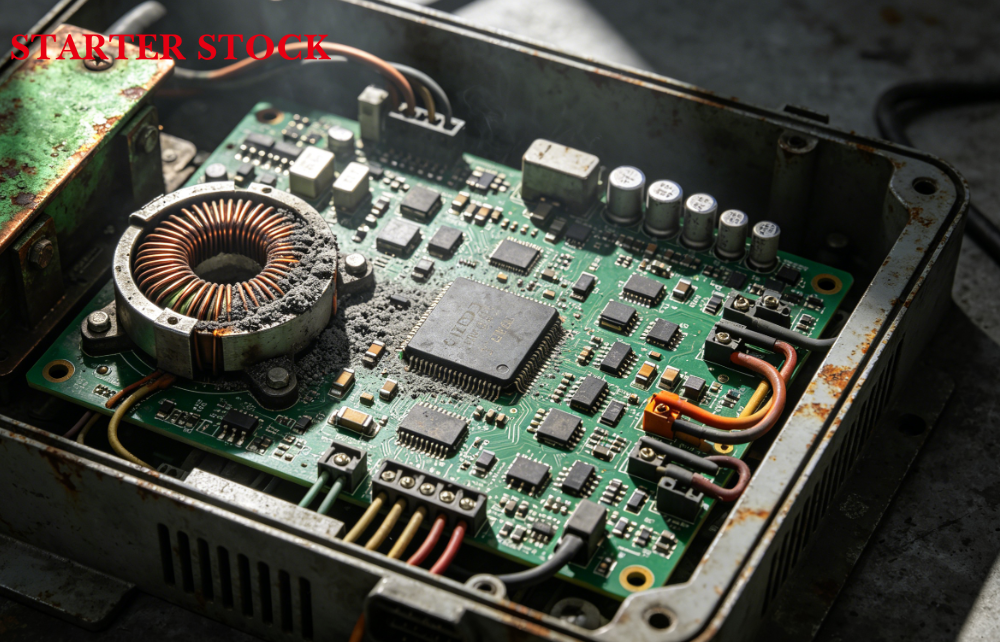
The Heat Penalty: This shunted current doesn't just disappear; it turns into thermal energy. This is why you see massive aluminum cooling fins on rectifier housings.
Thermal Runaway: If the unit is mounted in a pocket of dead air or near an exhaust header, the internal semiconductors will desolder themselves. In the B2B world, "burnt rectifiers" are almost always an airflow or mounting-surface issue, not a component defect.
4. SCR vs. MOSFET: The Reliability Gap
If you are sourcing for the global market, the biggest differentiator today is the switch from SCR to MOSFET (Metal-Oxide-Semiconductor Field-Effect Transistor) technology.
SCR units are "clunky"—they switch slowly and run hot. MOSFET regulators switch faster and have much lower internal resistance. They stay significantly cooler and provide a rock-solid DC voltage, which is non-negotiable for engines running GPS, digital fuel injection, or sensitive telemetry. Specifying MOSFET units on StarterStock is the most effective way to lower warranty return rates for high-performance applications.
5. Why the Symbiosis Breaks Down
In a workshop environment, you have to look at the magneto and rectifier as a single metabolic unit. Failure in one usually kills the other.
The Grounding Trap: A corroded chassis ground is the #1 killer of rectifiers. If the excess current can't find its way to the ground, it builds up inside the unit until the diodes pop.
Demagnetization: Permanent magnets aren't always permanent. Excessive heat or mechanical shock (like a dropped flywheel) can weaken the magnets. A "weak" flywheel won't produce the AC voltage needed to "break" the battery's resistance, leading to a chronically flat battery even if the rectifier is brand new.
Phase Imbalance: In a 3-phase system, if one stator coil burns out, the rectifier receives an uneven load. This forces the remaining diodes to work double-time, leading to a cascading failure of the entire charging loop.
The Bottom Line
The magneto and rectifier exist in a state of constant tension—one providing raw force, the other providing rigid discipline. For anyone in the procurement or repair sector, respecting this balance is the difference between a machine that runs for 5,000 hours and one that dies at 500. When spec'ing parts, prioritize heat dissipation and semiconductor quality over raw wattage every time.