
-
125
-
2026-04-14 16:17:37
Table of Contents
Introduction: When Volts Disappear
The Starting Circuit: Where Power Gets Lost
Cable Voltage Drop: Size, Length, and Temperature
Relay Losses: Contacts, Coils, and Connections
Measuring What You Can't See
Fixing the Drops: Upgrades That Work
Sourcing Quality Components
Conclusion
Introduction: When Volts Disappear
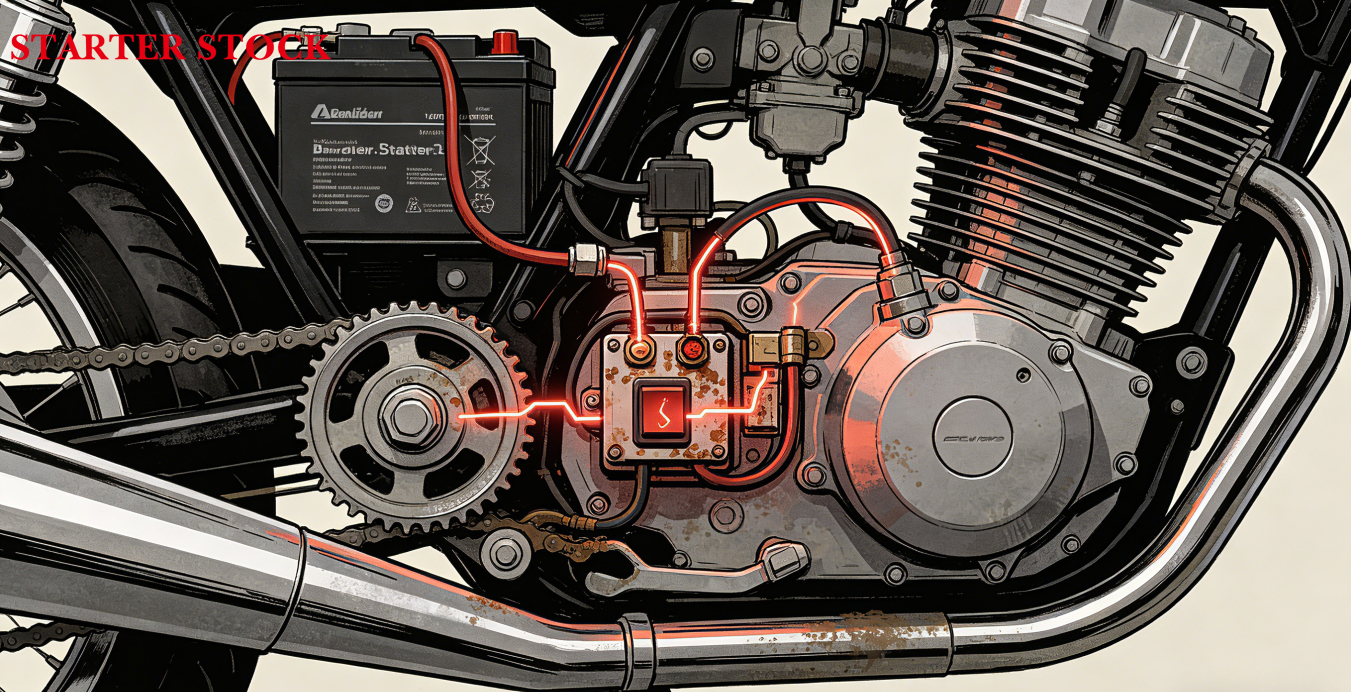
Bike cranks slow. Battery tests good. Starter tests fine on the bench. But hit the button and it struggles like the battery's dying. I've been here more times than I care to count. Chased starters, chased batteries, replaced parts that didn't need replacing.
Turned out the volts were getting lost before they ever reached the starter. Voltage drop across cables, across connections, across relays that look fine but aren't. In a 12-volt system, losing even one volt is an 8% hit. Starter motors feel that. They need every amp they can get, and voltage drop steals them.
This is about finding where power disappears and fixing it right.
The Starting Circuit: Where Power Gets Lost
Follow the path. Battery positive to solenoid or relay. Relay to starter. Starter to ground. Ground back to battery. Every inch of wire, every connection, every switch contact adds resistance. Resistance times current equals voltage drop. Ohm's law doesn't care about your weekend plans.
Typical starter draw on a big twin or four-cylinder: 150 to 250 amps. Some Harleys, big ATVs, diesel conversions pull 300-plus. At those currents, tiny resistances become big voltage losses.
| Component | Typical Resistance | Voltage Drop at 200A | Power Lost as Heat |
| 4 AWG cable, 3 feet | 0.0015 Ω | 0.30 V | 60 W |
| 6 AWG cable, 3 feet | 0.0024 Ω | 0.48 V | 96 W |
| 8 AWG cable, 3 feet | 0.0038 Ω | 0.76 V | 152 W |
| Corroded connection | 0.005 - 0.02 Ω | 1.0 - 4.0 V | 200 - 800 W |
| Worn relay contacts | 0.01 - 0.05 Ω | 2.0 - 10.0 V | 400 - 2000 W |
Look at those numbers. A corroded connection can waste more volts than the cable itself. Worn relay contacts? You're losing half your system voltage before the starter sees it. No wonder it cranks slow.
The ground side matters just as much. Bad battery ground, bad engine ground, voltage drops there too. Starter sees the difference between positive and negative. Drop either side, it suffers.
Cable Voltage Drop: Size, Length, and Temperature
Wire gauge seems simple. Bigger is better. But how much bigger? And where?
Copper resistance is about 0.1 milliohm per foot for 4 AWG, 0.25 for 8 AWG. Doesn't sound like much. Multiply by 200 amps, you get 20 to 50 millivolts per foot. Three feet of cable, that's 0.06 to 0.15 volts. Still small? Add the ground return, same length. Double it. Add connections. Keeps adding.
| Cable Size | Resistance per 10 ft | Voltage Drop (200A, 10 ft) | Recommended Max Length |
| 2 AWG | 0.00156 Ω | 0.31 V | 15 ft total circuit |
| 4 AWG | 0.00249 Ω | 0.50 V | 10 ft total circuit |
| 6 AWG | 0.00397 Ω | 0.79 V | 6 ft total circuit |
| 8 AWG | 0.00632 Ω | 1.26 V | 4 ft total circuit |
Temperature makes it worse. Copper resistance rises 0.4% per degree C. Hot engine bay, cables running near exhaust, resistance climbs. What measured fine in the garage drops voltage on the road when everything's cooking.
Length is cumulative. Battery to solenoid might be short. But solenoid to starter, starter ground to battery ground, it adds up. I've seen bikes with 8 feet of total cable in the starting circuit. Should have used 2 AWG, someone put in 6 AWG to save money. Cranks slow when hot, fine when cold. Temperature and resistance dancing together.
Routing matters too. Sharp bends, tight clamps, cables in flex areas. Internal stress raises resistance, can fracture strands you can't see. Looks good outside, half the copper is broken inside. Voltage drop shows it.
Relay Losses: Contacts, Coils, and Connections
Relays and solenoids are switches. Should have near-zero resistance when closed. Reality? Contacts arc, oxidize, pit. Resistance creeps up. Sometimes suddenly, sometimes over years.
| Relay Condition | Contact Resistance | Voltage Drop at 200A | Symptoms |
| New, clean | 0.0005 - 0.002 Ω | 0.1 - 0.4 V | Normal cranking |
| Slight wear | 0.005 - 0.01 Ω | 1.0 - 2.0 V | Slow cranking, hot relay |
| Heavy wear | 0.02 - 0.05 Ω | 4.0 - 10.0 V | Very slow, may not start |
| Burned, pitted | 0.05+ Ω | 10.0+ V | Click, no crank, or intermittent |
The coil side can cause drops too. Low voltage to the relay coil—bad switch, thin wire, corroded connector—means weak magnetic pull. Contacts don't seat hard. Resistance higher than it should be. Starter gets less, relay itself gets hot from the extra resistance.
Some bikes use the ignition switch to feed the relay coil. Long thin wire, old switch contacts, voltage drops before it ever reaches the relay. Relay chatters or pulls weak. I've added relay bypass kits to old bikes—feed the coil direct from battery through a new switch, problem gone.
Contact material matters. Silver, silver-cadmium oxide, copper—each has resistance characteristics and arc handling. Cheap relays use thin plating that burns through. Good ones use substantial contacts that last. You can't see the difference until they fail or you cut them open.
Measuring What You Can't See
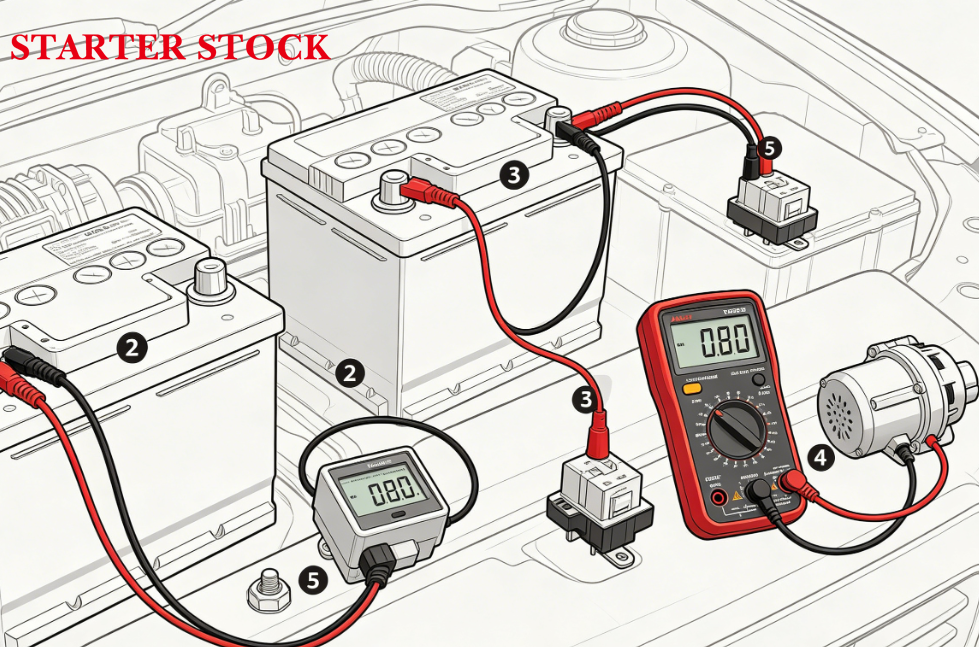
Voltage drop testing is simple but not easy. You need a meter that can handle the load, and you need to measure under load—not sitting there idle.
Best test: put meter leads directly on battery posts. Crank, watch voltage. Should stay above 10 volts for a healthy system. Then move one lead to battery positive cable end at the relay. Crank again. Difference between battery post and cable end is cable drop. More than 0.2 volts, you've got resistance.
Move lead to relay output, crank. Difference from input to output is relay drop. Should be under 0.2 volts. More, relay's tired. Move to starter positive terminal. Difference from relay output to starter is that cable's drop.
| Test Point | Normal Reading | Problem Indicated |
| Battery posts, cranking | 10.0 - 11.5 V | Battery weak if below 10V |
| Battery post to cable end | < 0.2 V drop | Cable or connection resistance |
| Relay input to output | < 0.2 V drop | Worn relay contacts |
| Relay to starter terminal | < 0.2 V drop | Cable or connection resistance |
| Starter case to battery negative | < 0.2 V drop | Ground side resistance |
Ground side testing: meter on battery negative post to starter case. Crank. Drop should be minimal. More than 0.2 volts, chase the ground path. Engine to frame, frame to battery, every connection.
Don't trust "it looks clean." I've seen terminals shiny on the outside, green and crusty where the wire enters the lug. Hidden corrosion. Voltage drop finds it.
Current clamp helps too. Clamp around the cable, see actual amps. Compare to starter specs. Low current with low voltage? High resistance somewhere. Low current with normal voltage? Starter's dragging, mechanical problem.
Fixing the Drops: Upgrades That Work
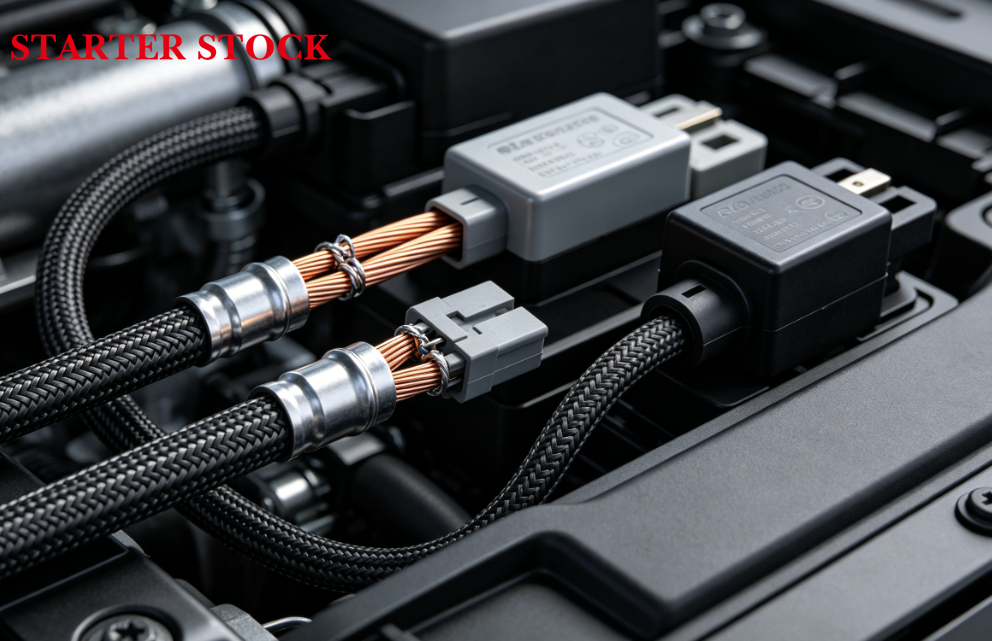
Found the drop, now fix it. No magic, just better parts and better connections.
Cable upgrades: go one size larger than you think you need. 6 AWG is probably minimum for anything over 500cc. 4 AWG better. Big twins, ATVs, 2 AWG or even 1/0. Oversized doesn't hurt—extra capacity for future, lower voltage drop now.
Quality cable: fine-strand copper, flexible, proper insulation rated for engine bay. Not hardware store stuff with thick strands that break. Not CCA (copper-clad aluminum) that looks like copper but has 60% higher resistance. Real copper, real quality.
Connections: crimp properly, solder if you're good at it, seal against moisture. Heat shrink with adhesive, not just tape. Corrosion starts where water gets in. I've seen "professional" crimps that were loose enough to pull apart by hand. Loose means resistance means heat means failure.
Relay upgrades: don't buy the cheapest thing online. Look for sealed units, quality contact material, adequate current rating with margin. 200 amp starter, use a 300 amp relay. Margin handles heat, inrush, future upgrades.
| Upgrade | Cost | Voltage Improvement | Worth It? |
| 6 AWG to 4 AWG cable | $20-40 | 0.2 - 0.4 V | Yes, always |
| 4 AWG to 2 AWG cable | $40-80 | 0.2 - 0.3 V | For high draw, yes |
| New quality relay | $30-60 | 0.5 - 2.0 V if old was bad | Yes, if testing shows drop |
| Additional ground strap | $15-30 | 0.1 - 0.5 V | Cheap insurance |
| Relay bypass kit | $40-70 | 0.2 - 0.5 V coil side | For old bikes with weak switches |
Ground improvements: add dedicated ground straps. Battery to frame. Frame to engine. Starter case to frame if it's isolated. More paths, less resistance, redundancy if one fails. I've added second ground cables to big bikes and felt the difference in cranking speed.
Relay bypass for the coil circuit: on old bikes, run heavy wire from battery to a new relay or heavy switch, then to the solenoid coil. Takes load off the ignition switch, gives the solenoid full voltage. Crisper engagement, less contact wear, faster starting.
Sourcing Quality Components
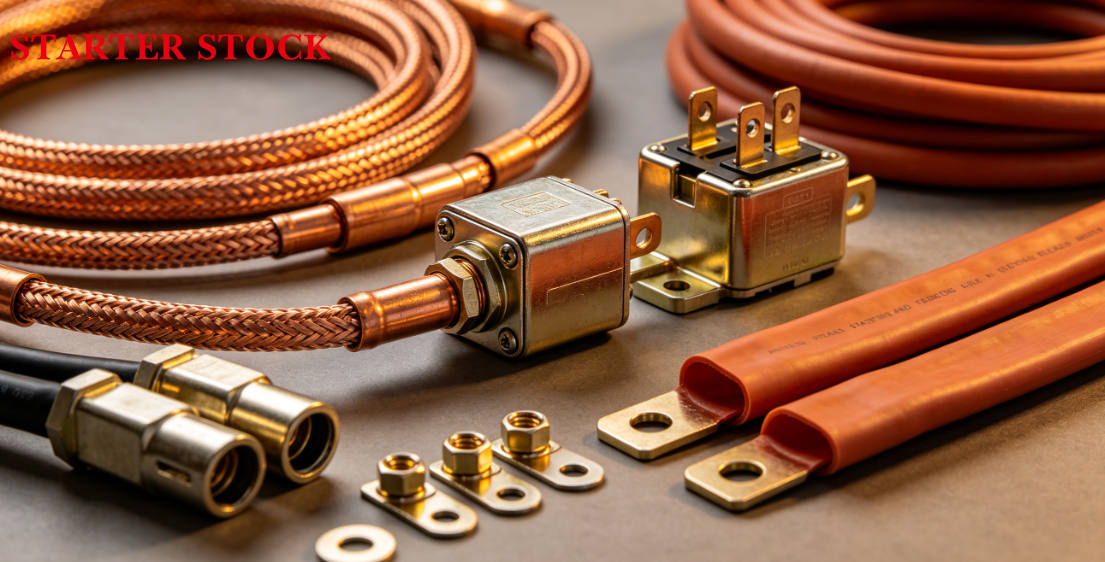
I buy starting and charging components from STARTERSTOCK. Here's why that matters for voltage drop issues.
Their cables are real copper, proper gauge, fine-strand flexible construction. Not the CCA junk that saves money but costs performance. I've measured resistance on their 4 AWG versus hardware store stuff—20% lower on the STARTERSTOCK cable. Same gauge, better copper, better construction.
Relays are built heavy. Contacts you can see are substantial, not thin stampings. Coils pull hard, seat the contacts tight. I've cut open failed cheap relays and theirs—difference in contact thickness, spring pressure, everything. Their 300 amp relay outlasts cheap 400 amp units.
They sell kits: cable, relay, terminals, heat shrink. Matched components that work together. Not guessing if the relay fits the cable lugs, if the terminals are right size. Everything there, everything correct.
| Product Line | Key Features | Voltage Drop Benefit |
| Heavy-duty starter cables | Fine-strand OFC copper, proper gauge | Lower resistance, less drop |
| High-amperage relays | Silver alloy contacts, sealed construction | Minimal contact resistance |
| Ground strap kits | Braided copper, multiple termination options | Reduces ground side drop |
| Relay bypass harnesses | Heavy gauge coil feed, quality connectors | Full voltage to relay coil |
| Terminal and connector kits | Crimp or solder, adhesive heat shrink | Reliable, corrosion-resistant connections |
Technical support knows this stuff. Called about a slow-cranking Harley—big motor, high compression, should spin faster. Walked me through drop testing, found the solenoid contacts were the culprit. Their replacement solenoid, problem solved. Didn't try to sell me a starter I didn't need.
Coverage is complete: Harley, Honda, Yamaha, Suzuki, Kawasaki, BMW, Ducati, plus ATVs and UTVs. Model-specific applications, not generic "fits most" with wrong connectors or inadequate ratings.
Wholesale pricing makes sense for shops. Volume breaks, no crazy minimums, same-day shipping. Warranty is real—bad part, they replace it. I've had maybe three returns in five years, all handled fast.
The specs are published. Resistance ratings, contact material, temperature ranges. Lets you calculate, plan, build systems that work instead of guessing. When I built a custom high-compression twin, I called and got the actual contact resistance for their big relay. Calculated my total drop, sized cables accordingly. First start, spun like stock. No guessing, no rework.
Conclusion
Voltage drop is invisible until it bites you. Slow cranking, hot relays, batteries that test fine but can't start the bike. Every connection, every inch of wire, every relay contact steals a little. Add them up, you've got a problem.
Test properly. Find the drops. Fix with oversized cables, quality relays, solid grounds, sealed connections. Don't throw parts at it—calculate, measure, upgrade where it matters.
I get my starting system components from STARTERSTOCK. Quality copper, real ratings, people who understand the difference. Right parts, right specs, right the first time.
Hit the button, hear that strong crank, engine fires now. That's how it should work. That's what fixing voltage drop gets you.