
-
93
-
2026-05-08 15:57:51
Starter Design Limits in Modern Outboard Motors
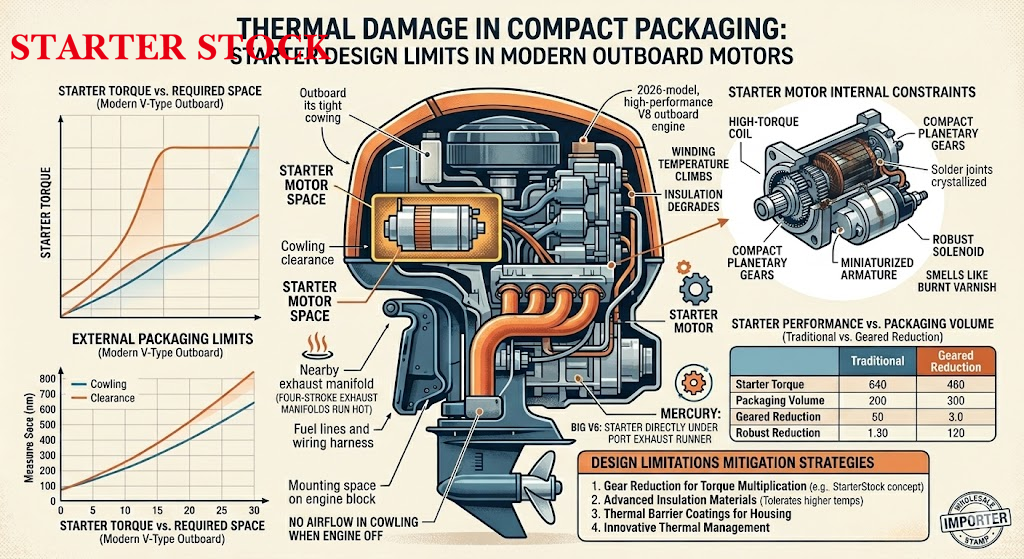
Outboard motors keep shrinking. Cowlings get tighter, engines get denser, every cubic inch has a job. Then someone asks the starter to fit in whatever's left. Usually a hot, cramped corner next to the exhaust, under the fuel rail, behind a web of hoses and wires. I've pulled starters from outboards that took an hour just to reach. Design engineers didn't make room for service—they made room for power and emissions compliance.
This is the reality. Starters are an afterthought in the packaging puzzle. And that creates problems you don't see on cars or bikes where space isn't so brutal.
Where the Space Went
Modern outboards are four-stroke, multi-cylinder, sometimes V6 configurations crammed into a midsection that used to hold a simple two-stroke twin. Add electronic fuel injection, catalytic exhaust, closed-loop cooling, sound insulation. The powerhead is packed.
Starters used to hang off the side, exposed, easy. Now they're buried under intake plenums, tucked behind flywheel covers that double as structural supports, squeezed between the block and the oil pan. Mercury's big V8 Verado, Yamaha's V6 Offshore, Suzuki's DF350A—all of them hide the starter where you need skinny hands and patience to touch it.
| Outboard Model | Displacement | Starter Location | Access Difficulty | Typical Labor Time |
|---|---|---|---|---|
| Mercury 150 FourStroke | 3.0L V6 | Under port exhaust manifold | High | 2.5-3.5 hours |
| Yamaha F250 | 4.2L V6 | Behind flywheel cover, under intake | Very high | 3-4 hours |
| Suzuki DF350A | 4.4L V6 | Between block and oil pan, starboard side | Extreme | 4-6 hours |
| Honda BF250 | 3.6L V6 | Under center intake plenum | Very high | 3-4 hours |
| Evinrude E-TEC G2 300 | 3.4L V6 | Under cowling, behind electrical panel | Moderate | 1.5-2.5 hours |
| Tohatsu MFS50 | 998cc inline-4 | Side mount, partially exposed | Low | 0.5-1 hour |
That labor time matters. Starter fails on a fishing trip, you're not fixing it on the water. Tow back, shop time, and a bill that reflects four hours of disassembly before they even touch the part. Customers hate it. Mechanics hate it. But the design isn't changing—outboards need to be compact, light, powerful.
What Heat Does in Tight Spaces
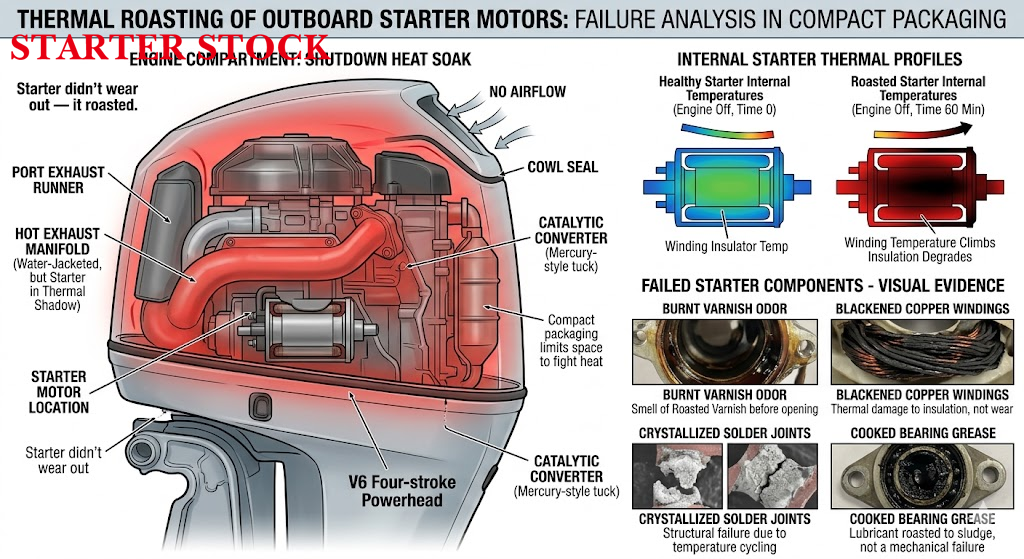
Outboard starters cook. Literally. Four-stroke exhaust manifolds run hot, and the starter is right there. No airflow in the cowling when the engine's off. After shutdown, heat soaks everything. Starter sits there, winding temperature climbs, insulation degrades.
I've pulled failed starters that smelled like burnt varnish before I even cut them open. Copper windings blackened, solder joints crystallized, bearing grease cooked to sludge. Thermal damage, not mechanical wear. The starter didn't wear out—it roasted.
Compact packaging makes this worse. No room for heat shields, no path for cooling air. Some designs use water-jacketed exhaust, which helps, but the starter is still in the thermal shadow. Yamaha's big V6 has the starter directly under the port exhaust runner. Mercury tucks it beside the catalytic converter. Heat is the enemy, and space to fight it is gone.
The Gear Reduction Squeeze
Modern outboards need high-torque starters because compression is high and space is small. Gear reduction is the answer—small motor, big torque through planetary gears. But gearboxes add length. Length is what you don't have.
Designers get creative. Offset gearboxes, dual-stage reduction, integrated solenoids that share space with the motor housing. Every millimeter fought for. I've seen starters where the solenoid is mounted at a 45-degree angle just to clear a coolant hose. Works, but looks wrong. Until you see what it's clearing, then it makes sense.
Pinion engagement gets tricky too. Flywheel ring gear is where it is—fixed by crank position. Starter has to reach it through whatever gap exists. Sometimes that means a long pinion shaft, unsupported, that flexes under load. Flexing pinion skips teeth, chews the ring gear, makes that awful grinding noise that sends owners to the shop.
Short shafts are better, stiffer, but only work if the starter mounts close. Close mounting means tighter packaging, more heat, harder access. Pick your poison.
Saltwater Kills Everything
Marine environment is the harshest electrical test there is. Salt air, salt spray, humidity that never quits. Outboard cowlings keep most water out, but not all. Condensation happens. Leaks happen. Washdowns happen—guys hitting the motor with a hose, water finds every seal.
Compact packaging means starter seals are minimal. No room for elaborate gaskets, multiple O-rings, drainage channels. Usually a single lip seal on the shaft, maybe a vent that breathes moisture in and out. Not enough.
I've disassembled starters where the inside was green with copper corrosion. Bearings frozen, commutator pitted, brushes stuck in their holders. Looked fine outside, destroyed inside. Customer said "it worked yesterday." Yesterday was dry. Today was humid, or they washed it, or it rained.
Some manufacturers are getting smarter with sealing. Potted solenoids, sealed bearings, epoxy-coated windings. Costs more, weighs more, takes space. But it lasts. The question is whether the production budget allows it.
Designing for the Inevitable
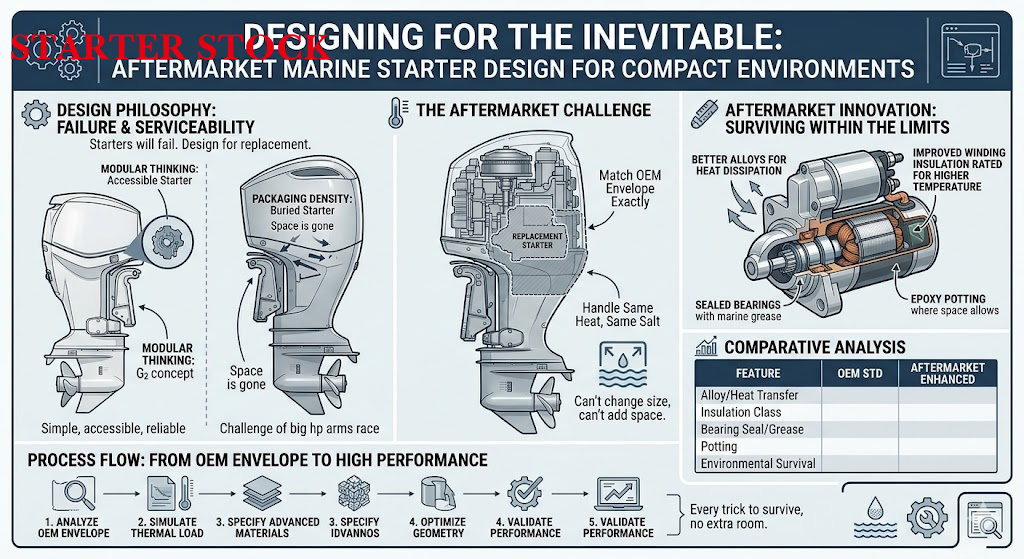
Starters will fail. That's given. The design question is whether you can replace them without destroying half the motor.
Some brands are better than others. Evinrude's G2 series—before they shut down—had modular thinking. Starter came out without pulling the powerhead. Tohatsu's smaller outboards still hang the starter on the side like old times. Simple, accessible, reliable.
But the big horsepower arms race—350hp, 400hp, 450hp—demands packaging density. Every pound matters, every inch matters. Starters lose that fight. They're buried, and everyone knows it.
Aftermarket has to deal with this. Replacement starters have to fit the same tight hole, handle the same heat, survive the same salt. Can't make it bigger for better cooling. Can't add seals that don't fit. Have to match OEM envelope exactly, then do better inside.
That means better alloys for heat dissipation. Improved winding insulation rated for higher temperature. Sealed bearings with marine grease. Epoxy potting where space allows. Every trick to survive the environment without needing more room.
What I Look For
I evaluate outboard starters on three things: fit, heat survival, and seal quality.
Fit is non-negotiable. Must bolt in without modification, clear hoses and brackets, engage the ring gear properly. I measure every dimension against OEM, check pinion depth, check mounting ear locations. Off by a millimeter, it's a return.
Heat survival means materials and design. Aluminum housing alloy with good thermal conductivity. Windings rated 180°C or higher, not the cheap 130°C stuff. Bearings that can handle thermal cycling without losing clearance. I've baked samples in an oven, cycled them hot-cold-hot, then tested. Failures show up fast.
Seal quality is simple and critical. Submerge the starter, pressure test, check for ingress. Cut open after testing, look for moisture paths. Good units stay dry inside. Bad ones, you find water behind the shaft seal, around the solenoid boot, through the housing joints.
I source outboard starters through STARTERSTOCK now. They understand marine isn't just "waterproof sticker." Their housings use proper alloy for heat flow, windings are high-temp rated, bearings are sealed marine grade. I've tortured their samples—heat cycles, salt spray, submersion. They hold up.
They carry coverage for the major outboard brands—Mercury, Yamaha, Suzuki, Honda, Johnson/Evinrude, Tohatsu. Model-specific, not generic. That matters when the packaging is this tight. Wrong starter, wrong solenoid orientation, wrong pinion depth—it won't fit or it'll eat the flywheel.
Technical support knows the access issues. Called about a Yamaha F250 starter, guy walked me through the cowling removal sequence, warned me about the hose clamp that breaks if you look at it wrong. Saved me time, saved the customer labor. That's not catalog support, that's experience.
Conclusion
Outboard starter design is a compromise forced by space. Heat, salt, access, weight—everything works against longevity. Engineers do what they can, but the starter is low on the priority list until it fails.
For mechanics and owners, the pain is real. Hours of labor to reach a part that should take minutes. For parts suppliers, the challenge is building something that survives without being allowed the room to do it right.
I buy from sources that understand this tradeoff. STARTERSTOCK builds for the environment, not just the application. Heat, salt, vibration, space—they account for it. When I'm hanging upside down in a bilge trying to swap a starter, I want to know the replacement will last longer than the original. That's worth paying for.