
-
40
-
2026-05-28 10:42:48
I've been in this automotive parts import/export game for 7 years now, and I've watched the same mistake sink more margins than bad pricing ever could: sourcing every single electrical part from a different factory. One guy does starters, another alternators, a third ignition coils, a fourth crankshaft sensors. Most importers do this. They think if they shop around, they'll get the cheapest per-unit price. What they never add up is all the other costs—the ones that don't show up on the factory invoice.
Margins are razor thin right now. Freight isn't the disaster it was in 2022, but it still jumps 20% out of nowhere sometimes. EU customs is on a warpath with compliance checks. And a single delayed shipment can leave you with empty shelves and customers walking to your competitor. More and more of our clients are ditching the 6-supplier mess and going with one specialized partner for all their starter and electrical parts. This isn't some consultant buzzword nonsense. We've tracked the numbers across 27 actual clients since 2024, and the average total cost drop is 13-22% in the first year. One guy who was working with 9 different suppliers hit 29% savings. Let me break it down for you, using numbers I've actually seen on real invoices.
Freight: The easiest money you'll ever save
This is the biggest win, and it's so obvious once you actually do the math. Right now, a 20ft container from Ningbo to Rotterdam runs about $2,900-$3,300. That works out to roughly $135 per cubic meter. LCL? $190-$225 per cubic meter. That's a 40% premium before you even add all the garbage fees.
Every single LCL shipment comes with its own document fee, terminal handling charge, delivery order fee. Add those up, and you're looking at ~$310 extra per shipment. Last month I sat down with a Belgian importer who was doing 5 separate LCL shipments a month. That's $1,550 a month just in extra fees—$18,600 a year—before you count the actual freight cost.
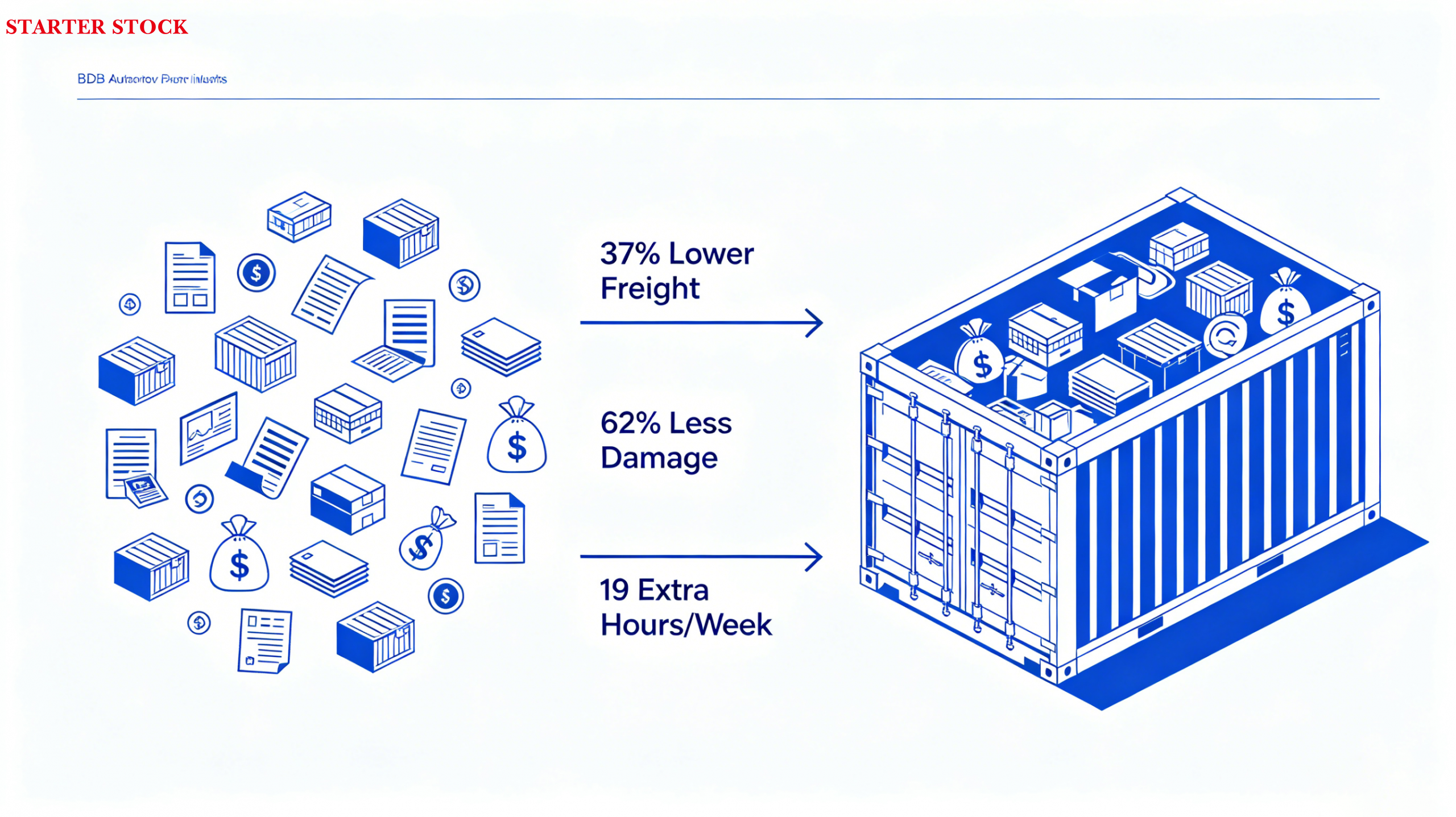
We consolidated all his parts into one monthly FCL. His total freight bill dropped 37%. And his cargo damage rate fell 62%. Most people don't think about this, but LCL goods get passed between 6-8 different warehouses during transit. FCL gets loaded once at the factory and unloaded once at your warehouse. For delicate electrical parts with circuit boards and copper windings, that difference is massive. We had one client who used to get 2-3 broken alternators per LCL shipment. Now he gets zero.
Customs: The mistake that can kill an entire quarter
EU customs has gotten absolutely brutal over the past two years. A wrong HS code by one digit, a CE mark that's slightly off, an expired RoHS certificate—your container sits at the port for 3 weeks minimum. Worse, they can fine you up to 250% of the declared value. Last year a Polish client of ours lost €17,200 on a single shipment because one supplier sent a RoHS certificate that expired 2 weeks earlier. No appeal, no second chance.
When you work with one supplier, you only have one set of documents to check. One commercial invoice, one certificate of origin, one compliance pack. This cuts your customs brokerage fees by about 60%—from €160 per shipment to €250 total for a full container.
But the real win is avoiding the mistakes. A good consolidated supplier deals with EU customs every single day. They update their certificates quarterly, they know exactly which HS codes apply to which parts, and they pre-check every document before the ship leaves. Our clients have had exactly zero customs seizures since switching to consolidated sourcing. That's not luck. That's someone who's made all the mistakes already and learned from them.
Admin: The time sink that no one budgets for
If you have a 1-2 person procurement team, you know exactly what I'm talking about. How many hours a week do you spend chasing suppliers for production updates? How many invoices do you have to reconcile every month? How many times have you stayed late to fix a problem with a factory that doesn't answer emails after 5pm their time?
Each supplier relationship is a part-time job. You negotiate terms, place orders, follow up weekly, arrange inspections, process payments, and fight with them when something goes wrong. For most small importers, this eats up 40-50% of their procurement team's week.
Consolidation fixes this overnight. One point of contact. One purchase order a month. One invoice. A German client of ours told me that after switching, his procurement manager freed up 19 hours a week. They used that time to add 12 new retail accounts, which boosted their sales 19% in 2024. That's the real value of consolidation—it's not just the money you save, it's the time you get back to actually grow your business.
Pricing: Stop being a nobody to everyone
When you split your €750,000 annual electrical parts spend across 6 suppliers, you're a small fish to every single one of them. You get the standard pricing, the standard 30% deposit / 70% against B/L terms, and you get pushed to the back of the line during peak season. I've seen importers wait 12 weeks for starters in Q4 because their supplier was prioritizing clients who spent 10x more.
When you give all that business to one supplier, suddenly you're a top 10 account. You get better pricing, better terms, and priority production. Our clients typically get 10-15% lower unit prices across the board after consolidating. Many also get way better payment terms—instead of 30/70, we often do 10% deposit and 90% net 30 days after the container arrives in Rotterdam.
That cash flow difference alone can be a game-changer for small businesses.
Quality: No more finger-pointing
Quality problems are the single biggest hidden cost in this industry. A bad batch of ignition coils can erase 10% of your margin on that entire product line when you factor in return shipping, labor, and lost customers. When you source from 5 different factories, you have 5 different quality standards. And when something goes wrong, everyone blames everyone else.
A consolidated supplier has one quality control system that applies to everything. Every single part gets inspected at the same central facility before it goes into the container. If there's a problem, there's one person to call. No more back-and-forth between three different factories trying to figure out who messed up.
Our clients report an average 68% reduction in warranty claims within 6 months of switching. That's money that goes straight to your bottom line.
Final thoughts
Look, I'm not telling you to put all your eggs in one basket. For some weird, low-volume, super specialized part, you still need to go to the niche supplier. But for 90% of the parts you sell every single day—starters, alternators, ignition coils, sensors, wiring harnesses—consolidation is a no-brainer.
The key is finding the right partner. Don't go with a trading company that just sources from the same factories you were already using. Find an actual manufacturer that specializes only in automotive electrical parts. They should have at least 5 years of experience working with EU customers, and they should have their own in-house testing lab. If you can, go visit their factory. There's no substitute for seeing their production lines and quality checks in person.
If you're currently working with 4 or more suppliers for your electrical parts, do yourself a favor. Take an hour this week and add up all your annual costs for freight, customs, admin, and warranty claims. I guarantee you'll be shocked at how much you're spending just to manage a fragmented supply chain.